
What Climate Change Officers Actually Do
/Written by Daniel Kreeger, Executive Director, ACCO
Download a PDF of the executive summary
For seventeen years, I've been making the same argument in different rooms.
Organizations need climate change officers because no specialist working alone can do the work that climate change actually requires.
The argument has gotten more pointed as the stakes have gotten higher. In 2026, with regulatory frameworks tightening, disclosure requirements multiplying, and climate-related litigation expanding, the case for the role isn't just clearer. It's harder to ignore.
This is what climate change officers actually do. Why the role exists. And why it can't be substituted by hiring a climate scientist, expanding the sustainability team, or assigning the work to risk management.
The Substitution Problem
Most organizations approach climate the same way. They identify it as a priority. They hire a specialist, or designate one from existing staff. Then they expect the specialist to handle it.
The specialist might be a climate scientist, a sustainability director, a risk officer, or a chief resilience officer. The job description varies by sector. The underlying assumption is consistent: that climate is a domain, like cybersecurity or supply chain, that can be addressed by adding a discrete capability to the org chart.
It just doesn't work that way. Climate change cuts across every operational domain an organization runs:
Strategic planning
Finance
Legal
Governance
Operations
Supply chain
Real estate
Human resources
Risk management
Disclosure
Adding a single specialist to the org chart leaves the integration work undone. The result is what I've watched play out in organization after organization for nearly two decades. Ambitious commitments. Well-intentioned specialists. An inability to translate either into operational reality.
The role of the climate change officer exists because integration across domains is itself a discipline. It requires its own competencies, its own methods, its own training. It's not what climate scientists are trained to do. It's not what sustainability managers are trained to do. It's not what lawyers, risk officers, or strategic planners are trained to do.
It's a distinct professional function. Organizations that don't recognize it as such will continue to underperform their own commitments.
Four Functions (Not One)
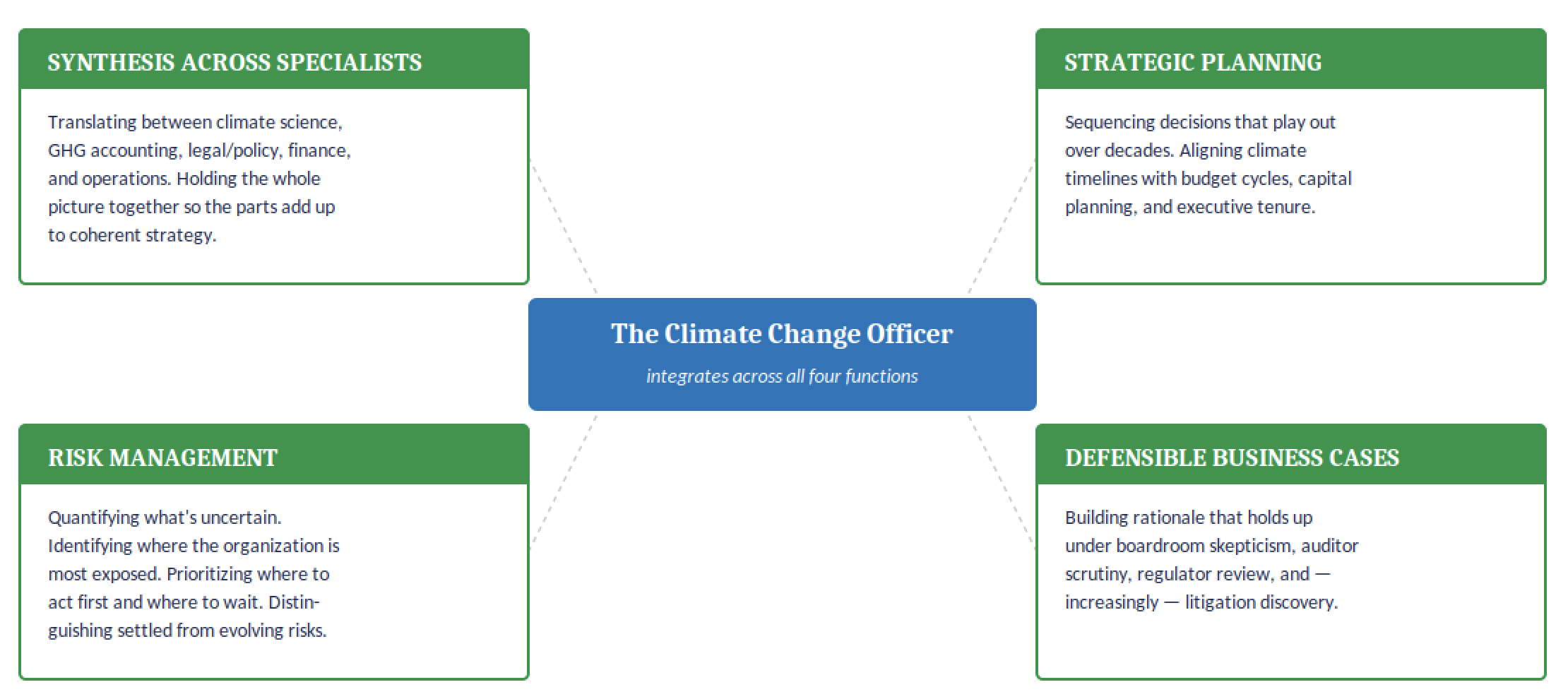
The climate change officer's work covers four distinct functions. Each is essential. None is sufficient on its own.
Synthesis Across Specialists: Climate change officers translate between domains. They work with climate scientists to interpret what regional projections actually mean for a specific facility. They work with GHG accountants to understand what a Scope 3 number does and doesn't tell you. They work with attorneys to understand what disclosure rules require versus prohibit. They work with finance to model the difference between physical risk and transition risk on a balance sheet. The job isn't to replicate any specialist's depth. It's to hold the whole picture together and make sure the parts add up to a coherent strategy.
Strategic Planning: Climate operates on timelines that don't fit standard organizational rhythms. Capital infrastructure decisions made today determine emissions and exposure for decades. Net-zero commitments span 25 years. Scenario analyses run out to 2050 and beyond. Climate change officers do the work of sequencing. What has to happen first. What depends on what. Where to invest now versus where to wait. How to align climate timelines with budget cycles, capital planning processes, and executive tenure.
Risk Management: Climate risk is uncertain. Uncertainty isn't an excuse to avoid quantification. Climate change officers identify where the organization is most exposed, what the magnitude of plausible loss looks like, where the cost of inaction exceeds the cost of action, and where the prudent response is to wait for better information. They build the analytical infrastructure that lets executives make decisions in the face of irreducible uncertainty: scenario analysis, materiality assessment, transition planning, adaptation prioritization.
Defensible Business Cases: This is the function that has changed most in the last five years. A climate change officer's job is to build the rationale for an investment, a commitment, a disclosure, a strategic decision, that holds up under scrutiny. Five years ago, "scrutiny" mostly meant the CFO's pushback or a skeptical board member. In 2026, it means something different.
Why "Defensible" is the Key Word in 2026
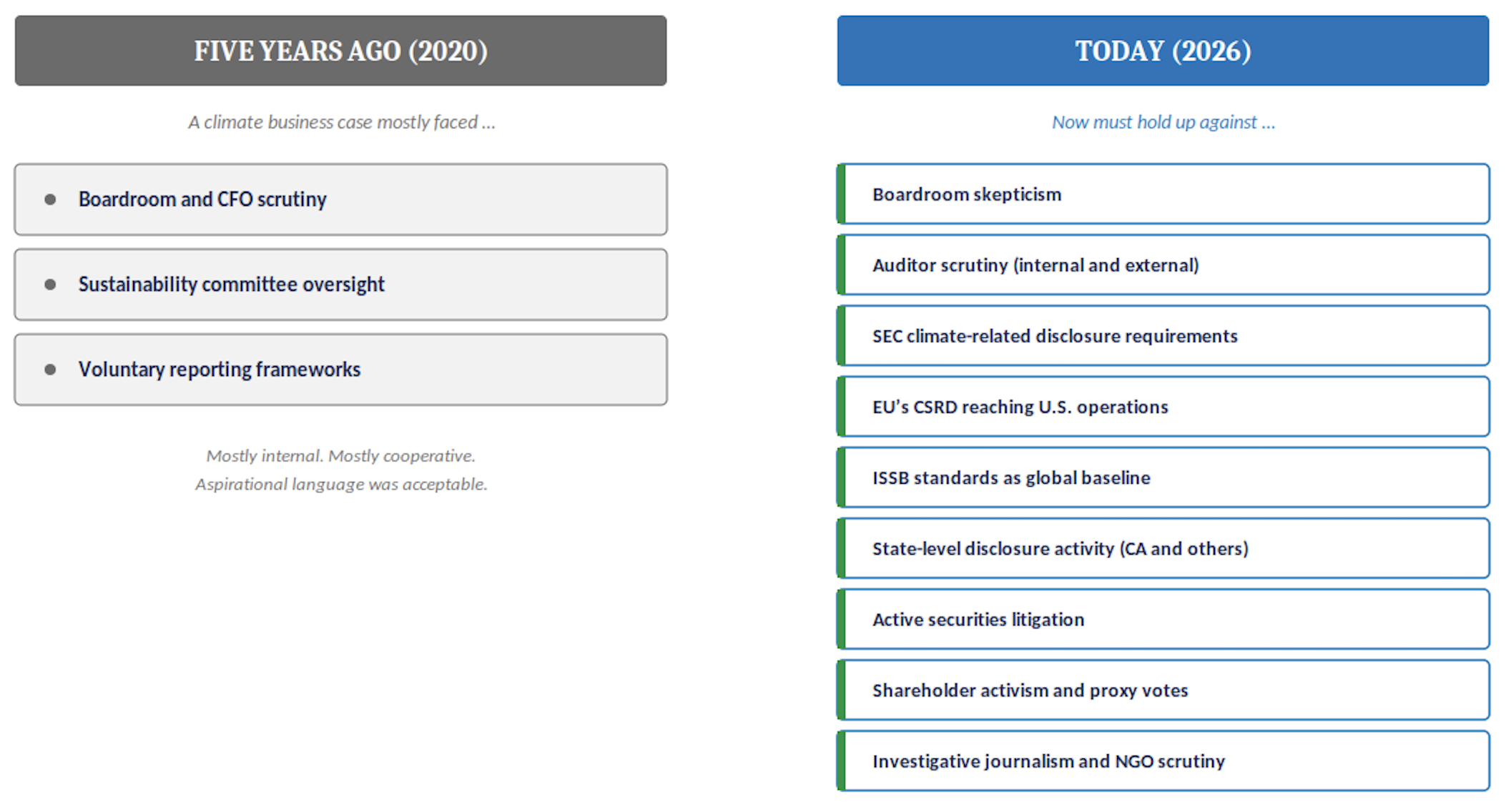
A meaningful share of climate-related decisions, commitments, and disclosures now get tested by people with access to internal documents, expert witnesses, and a strong incentive to find weaknesses. That includes:
The U.S. Securities and Exchange Commission's climate-related disclosure requirements, and parallel state-level activity (California and others) that's filling gaps the federal rules don't cover.
Europe's Corporate Sustainability Reporting Directive, which reaches U.S. companies with European operations and requires disclosure on a level of granularity that exposes the assumptions behind any climate claim.
The International Sustainability Standards Board's standards, increasingly adopted as the baseline disclosure framework outside the U.S.
Active securities litigation around climate-related disclosure, including cases involving major oil companies, financial institutions, and asset managers facing claims of misleading climate statements or greenwashing.
Increasing scrutiny of net-zero commitments and corporate climate plans by regulators, journalists, shareholder activists, and an increasingly sophisticated NGO community with the legal and analytical capacity to test claims rigorously.
Whatever you think of any specific rule or case, the operational reality is that climate-related work product now needs to hold up under hostile review.
A net-zero commitment that doesn't survive auditor inquiry is a liability, not an asset. A scenario analysis that can't withstand expert challenge in litigation discovery is worse than no scenario analysis. A disclosure that doesn't match what the organization actually believes is a securities exposure.
The climate change officer's job, in this environment, is not to make claims that sound good in a sustainability report. It's to build cases that survive when the questions get hard. That requires:
Methodology
Documentation
Scenario rigor
A clear-eyed sense of what the organization can and cannot defensibly say
It also requires the discipline to push back internally when the case doesn't hold. To tell the CEO that the commitment isn't supportable. To tell the board that the disclosure needs to be rewritten. To tell the head of communications that the press release overstates what the data show.
This is harder than it sounds. It requires standing in the room and saying things people don't want to hear. It requires being right often enough to be trusted, and humble enough to acknowledge what's still uncertain. It requires the technical fluency to engage with specialists across domains and the strategic perspective to see how the pieces fit together.
What is Required of this Role?
The skill profile for climate change officers is consistent across sectors.
Fluency Across Domains: Climate science, GHG accounting and management, regulatory frameworks, finance and economics, governance, ethics, and adaptation planning. Not specialization in any of these. Fluency across all of them. The integrator's job is to engage substantively with specialists in each domain, recognize what they're saying and what they're not, and synthesize across them. A climate change officer doesn't need to model a glacier or audit a Scope 3 boundary. They need to know when a glacier model is being misapplied or when a Scope 3 boundary is being drawn to flatter a number.
Translation Capability: Climate change officers spend much of their time translating. Technical content for executives. Executive priorities for technical teams. Regulatory requirements for operational teams. Internal positioning for external audiences. The translation has to be accurate in both directions. Oversimplification produces decisions that don't account for what specialists actually know. Excess technical detail produces executive disengagement. Doing both well is a skill. It has to be trained.
Disciplined Scenario Thinking: Climate change officers work in conditions of irreducible uncertainty. They have to make recommendations without certainty, hold positions without overconfidence, and adjust as new information arrives. Scenario analysis, done rigorously with explicit assumptions and clear ranges, is the analytical infrastructure for working under these conditions. Done badly, it's narrative cover for decisions already made. Done well, it's the basis for decisions that hold up.
Documentation Rigor: Every analysis a climate change officer produces could be reviewed later. By an auditor, a regulator, a litigant, a successor, an investigative journalist. Documentation has to assume that scrutiny. Assumptions need to be explicit. Methodology traceable. Decision rationale recorded. This isn't bureaucratic exercise. It's the difference between an analysis that can defend the organization's position and one that can't.
Ethical Clarity: Climate change officers need a clear sense of what the organization can and cannot defensibly claim. They need to be willing to say no. To a commitment that isn't supportable. To a disclosure that doesn't match the data. To a strategic narrative that overstates what the work product justifies. Without that, the role becomes a sustainability communications function. With it, the role becomes the organization's defense against decisions that won't hold up.
Why Specialists Cannot do this Alone
None of the functions above can be delegated to a domain specialist working alone.
The climate scientist's job is to produce the climate science. Not to translate it into a strategic plan. The GHG accountant's job is to produce the inventory. Not to integrate it with the financial disclosure. The attorney's job is to advise on the legal exposure. Not to make the business case for the underlying decision. The risk officer's job is to manage enterprise risk across all categories. Not to develop the climate-specific scenario infrastructure.
Specialists are essential. The argument isn't that organizations should hire fewer climate scientists or rely less on lawyers. The integration work, including synthesis, planning, risk management, and defensible-case-building, requires its own role, with its own training, accountable for its own outputs.
Without that role, the specialists can produce excellent domain work. The organization can still fail at the integration.
This is the structural argument for the climate change officer. It's why the role exists. It's what training for the role has to deliver. And in 2026, with stakes rising and scrutiny intensifying, it's more important than it has ever been.
The Association of Climate Change Officers credentials professionals who do this work through the Certified Climate Change Professional® program, built around a curriculum currently being refreshed for the 2026 environment. The credential's framework is designed to train integrators who can do the job the moment requires.
— Dan