The CC-P® Is Being Refreshed for 2026 | ACCO
/The CC-P® credential is being refreshed for 2026 with updated curriculum, a new cohort-based learning model, and a comprehensive Study Guide. Public town hall June 18.The CC-P® credential is being refreshed for 2026 with updated curriculum, a new cohort-based learning model, and a comprehensive Study Guide. Public town hall June 18.The CC-P® credential expanded into seven new countries in 2025: Bangladesh, Germany, Palestinian Territory, Romania, Serbia, Thailand, and Trinidad and Tobago.
Read MoreThe City of Norwalk has named Jodi Trendler as its first Director of Sustainability and Resilience. The role was established through ACCO's Future CCOs Program.ACCO has established an 18-member CC-P® Board comprised entirely of practicing CC-P® professionals to govern the credential's requirements, ethics, and advancement.ACCO has launched digital certificates and verifiable badges for CC-P® professionals, enabling instant employer verification and easy LinkedIn integration.ELC joined the Future CCOs program as an employer in 2021. Alina was hired into a permanent full-time position at the conclusion of her fellowship in January 2022. ELC then hired another ACCO fellow in May 2022, who will be publishing a subsequent case study in the next few months.
About the Future CCOs Post-Graduate Climate Fellowship Program
The Future Climate Change Officers Fellowship Program (Future CCOs) is designed to connect masters-level graduates with employer organizations seeking talented climate change practitioners. Centered on this professional talent pool, the program is establishing a professional track for graduates pursuing opportunities in climate change leadership.

Alina Rodriguez
Assistant Manager, Science Based Targets
Global Corporate Citizenship & Sustainability
Former ACCO Future CCOs Fellow
(2021-2022)
The Estée Lauder Companies Inc.
Alina Rodriguez was the first fellow in the program to be hired by a previous Future CCOs Fellowship Program. She was hired by Ran Tao, who was ACCO’s inaugural Future CCOs Fellow at the Coca-Cola Companies from 2013-2015.
CONTACT:
Daniel Kreeger
202-997-8673
dkreeger [at] climateofficers.org
WILMINGTON, Del. – Governor Carney on Monday announced that state agencies and local governments can learn how climate change is impacting Delaware, how we can best prepare for these challenges and how we can take advantage of opportunities for improving resilience and reducing emissions through a training offered by the State of Delaware.
Delaware is partnering with the Association of Climate Change Officers (ACCO) to begin offering the Delaware Climate Leadership Academy this spring.
The virtual training will provide instruction on understanding climate science and assessing vulnerability; basics of greenhouse gas accounting, reporting, disclosure; engaging organizational and community stakeholders to lead change; the economics of climate change; and managing climate risk.
“Delawareans expect their state agencies and local governments to provide solutions to a range of issues impacting our communities,” said Governor Carney. “Climate change affects every corner of state and local government operations — from preparing our labor force for the jobs of tomorrow to providing clean drinking water to collection of revenues — and that’s why it is critically important that we build climate change knowledge and skills in our state and local workforce. Delaware’s Climate Leadership Academy is a meaningful step forward in making sure we are prepared to respond to the global climate change challenge.”
Governor Carney released Delaware’s Climate Action Plan last November. The plan outlines actions the state can take to minimize greenhouse gas emissions and maximize resilience to climate change impacts. It also calls for training staff in state agencies and local governments to better prepare them to meet the challenges ahead.
The Academy, which will be administered by the Delaware Department of Natural Resources and Environmental Control, will provide training that integrates concepts of climate change mitigation and adaptation into the decision-making process. It will also be an opportunity for participants to network and collaborate on challenges and opportunities.
ACCO has provided training to more than 3,000 practitioners in public and private sectors. Most recently, it developed training and climate leadership academies for Maryland and Pennsylvania.
Delaware’s Climate Leadership Academy will include sessions specific to the First State, including:
Delaware-specific data
Information on Delaware’s Climate Action Plan
Delaware’s greenhouse gas emissions and initiatives already in place to reduce them
Maximizing resilience, with a focus on adapting to increasing temperatures, precipitation, flooding and sea level rise.
“Delaware has taken the vitally important step toward educating and training policymakers in state and local government, as well as building a climate smart workforce across sectors to ensure a healthy, secure and prosperous state,” said Daniel Kreeger, Executive Director of ACCO. “The Delaware Climate Leadership Academy will play a key role in building up the knowledge and skills in government and critical infrastructure that Delaware needs to address both the challenges and opportunities that lie ahead.”
The academy series will satisfy elective requirements to become a candidate for the Certified Climate Change Professional exams and become a candidate for the professional CC-P credential. Training is planned to be offered again in the fall to a larger audience of non-government stakeholders.
The deadline for state and local government employees to register is April 21. For more information and to register, visit https://de.gov/climateacademy.
###
Climate change is a threat to U.S. national security and homeland security. In fact, the impacts of climate change are a threat to the health, security and economic vitality of all nations. These statements are consistent with and reflected by the findings of the 2010 and 2014 Defense Quadrennial Reports, numerous Government Accountability Office reports, the World Economic Council's Global Risk Report, the National Climate Assessment and the Intergovernmental Panel on Climate Change.
Migration and displacements of large bodies of people is one of the most concerning impacts of climate change. Developing countries around the world and communities with the least resilient and most aging infrastructure throughout the United States are prime candidates for these impacts. We have seen these devastating consequences in New Orleans after Hurricane Katrina, the middle east uprisings after record famines impacting wheat and potato crops grown in Russia and China caused basic food staple prices to go through the roof, and more recently, as Brookings reported last year, heavily contributed to the migrations we’ve seen from Honduras.
Agencies at all levels of government charged with the mission of protecting borders, infrastructure, public health and economic vitality, and those charged with conducting emergency management activities, need to be able to model and plan for these impacts, and develop strategies and policies for meeting these unprecedented challenges that climate change is already posing to our communities today, and will increasingly pose to our communities in the future.
— Daniel Kreeger, Executive Director, Association of Climate Change Officers

Our commitment to you is to advance and support the climate change community of practice (particularly in this time of need). We will be more than the sum of our parts!
Here’s what ACCO is doing immediately in response to this pandemic:
Activities Open to the Public:
Virtual
Town Halls
Join peer practitioners for a group discussion on what we can do and need to do as a community. The first two are March 24 & 26. RSVP here.
Live
Online Training
Our in-person training is now being offered as Live Online Training, and we’ve even announced a scholarship program for those facing economic hardships.
Interactive
Podcast Series
Thought leaders join ACCO for a new live podcast series. Featured daily topics will include addressing our response to the pandemic and personal resilience discussions. More info coming soon.
CC-P® Candidate
Program
Don’t yet have the experience to qualify for the Certified Climate Change Professional® (CC-P®) credential? A new candidate program is coming this week.
For ACCO Members:
$1/month
Membership
This week, we will introduce a $1 per month membership for the first 6 months of membership for those facing economic hardships.
Member
Peer Clusters
ACCO has launched a matchmaking program to facilitate groups of 6-10 practitioners who will collaborate on professional interests and personal resilience on a regular basis.
New Working
Groups
Join forces with peers to work together on important solutions and challenges, particularly looking at challenges and opportunities for our field during this pandemic.
Career
Counseling
Lost your job? Trying to figure out how to make yourself a resource today in pandemic response? We are happy to help you or connect you to peers who can help you.
Unity will enable us to overcome these challenges.
I invite you to join our community of practice.
With fond wishes in this trying time,
Daniel M. Kreeger
Executive Director
Association of Climate Change Officers
Contact: Daniel Kreeger | dkreeger@ClimateOfficers.org | 202-997-8673
ANNAPOLIS, MD – January 29, 2020 – Maryland Governor Larry Hogan today recognized 40 professionals as Maryland’s first Certified Climate Change Professionals®, an international credential administered by the Association of Climate Change Officers (ACCO), during the meeting of the Board of Public Works.
Maryland Governor Larry Hogan recognized 40 professionals as Maryland's first Certified Climate Change Professionals® — watch the event by clicking on the photo above.
The 40 professionals recognized today, mostly consisting of state agency and local government personnel, earned their certifications by participating in 6 days of training provided through the Maryland Climate Leadership Academy and satisfying the credentialing requirements, which included passing 4 exams and satisfying 14 hours of elective requirements. “We are really proud of the Climate Leadership Academy,” said Governor Hogan. “It’s the nation’s first state-sponsored training institute.”
The graduates were presented State of Maryland & ACCO co-endorsed certificates and honored by Gov. Hogan, Comptroller Peter Franchot, Treasurer Nancy Kopp and Maryland Department of Natural Resources Secretary Jeannie Riccio.
“Our goal is to equip leaders and Maryland’s workforce with the skills and knowledge needed to meet the challenges of climate change, flooding and severe weather,” Maryland Department of Natural Resources Secretary Jeannie Riccio said. “Thank you Governor, Madam Treasurer and Mr. Comptroller for recognizing the commitment and leadership of Maryland’s first class of Certified Climate Change Professionals.”
“One of the major reasons that [Charles County was recently] given a triple A bond rating by Standard & Poor’s was citing of their work in preparation for resilience, most particularly their strong participation in the Academy,” said Maryland State Treasurer Nancy Kopp.
In recognizing these professionals and future Maryland Climate Leadership Academy participants, the State of Maryland became the first American state to formally recognize the ACCO credential. “It is crucially important that policymakers invest in training their workforce to drive climate change initiatives in critical infrastructure, public services and agency operations,” said Daniel Kreeger, ACCO’s executive director. “Maryland is leading this charge and is also recognizing the professionals who are role models for these competencies. We hope that other US states will quickly follow Maryland’s lead in building a competent workforce equipped to reduce our emissions while ensuring our security, public health and economic vitality through a dynamically changing climate.”
The Maryland Climate Leadership Academy was established in 2018 to specifically offer training and continuing education for state and local government officials and infrastructure professionals on the matter of climate change. The state developed the Academy in partnership with the Association of Climate Change Officers (read more about the Academy at www.MDClimateAcademy.org); the Maryland Department of Natural Resources is the designated state agency lead for the academy on behalf of the state.
To date, the Academy has trained more than 450 professionals through six cohorts conducted at community college and community centers across the State of Maryland. Additional training programs will be conducted in 2020 beginning in February in Annapolis.
The following professionals were recognized at the event and are the first Certified Climate Change Professionals® (CC-Ps®) in Maryland:
Laura Armstrong – Director, Sustainability Program, MD Dept. of the Environment
Maria Bernadzikowski – Sr. Emergency Management Specialist, Office of Emergency Management, Howard County Government
Joyce Breiner – Executive Director, Poolesville Green, Inc.
Katie Canady – Emergency Management Specialist II, Office of Emergency Management, Howard County Government
Nicole Carlozo – Coastal Planner, Center for Coastal Planning, Chesapeake & Coastal Service, MD Dept. of Natural Resources
Bernard Cochran – Deputy Director, Public Works Utilities, Charles County
Christine Conn – Director, Office of Science and Stewardship, Chesapeake and Coastal Service, MD Dept. of Natural Resources
Morgan Corey – Sustainable Fisheries Team Staffer, Chesapeake Research Consortium
Sarel Cousins – Administrator/Planner, MD Dept. of Agriculture
Jennifer Dopkowski – Management & Program Analyst, National Oceanic and Atmospheric Administration
John Ferri – Architect/Planner, DOL/Engineering Support Contractor
Steve Findley – Planner Coordinator, Maryland-National Capital Park and Planning Commission, Montgomery County
Linda Garoute – Chief Executive Officer, Cedar Haven Civic Association on the Patuxent River, Inc.
Anne Gilbert – Volunteer Coordinator & Urban Forestry Staff, MD Dept of Natural Resources, Forest Service
Beth Gingold – Founder, Recycle Leaders LLC
David Guier – Senior Director, Office of Grants and Projects, Global Communities
Michael Hinson – Deputy Director, Howard County Office of Emergency Management
Adriana Hochberg – Assistant Chief Administrative Officer, Montgomery County Government
Wendy Howard – Executive Director, One Montgomery Green
Susan Larcher – Senior Environmental Scientist, Arcadis
Jill Lemke – Manager, Strategic Planning and Special Projects, Maryland Port Administration, MD Dept. of Transportation
Helga Luest – Senior Manager, Communications, Abt Associates
Catherine Matta – Biologist, U.S. EPA
Christopher Meyer – Program Manager, Office of Emergency Management, Howard County
Lynn Miller – Assistant Planning and Zoning Officer, Anne Arundel County Office of Planning & Zoning
Karyn Molines – Division Chief, Natural Resources, Calvert County
Deborah Moran – Sustainability Coordinator, City of Gaithersburg
Angela Ober – Environmental Planner, Towson University
Nicole Okuniek – Environmental Planner, Howard County Government
Amy Pelsinsky – Director of Communications, University of MD Center for Environmental Science
Anastasia Poulos – Archaeological SItes Planner, Anne Arundel County
Samir Qadir – Environmental Scientist, Potomac-Hudson Engineering, Inc.
Carissa Ralbovsky – Supervising Budget Examiner, Office of Budget Analysis, MD Dept. of Budget & Management
Elissa Reineck – Sustainability Project Manager, Howard County
Laura Rogers – Program Manager, MD Dept. of Transportation
Matthew Rowe – Assistant Director, Water and Science Administration, MD Dept. of the Environment
Grant Samms – Rural Energy Project Coordinator, Center for Environment & Society, Washington College
John Samoryk – Vice President, Procurement, MD Stadium Authority
Alison Santoro - Restoration Specialist, Center for Habitat Restoration, Chesapeake & Coastal Service, MD Dept. of Natural Resources
Emily Soontornsaratool – Chief, Energy Data & Sustainability Initiatives, MD Dept. of General Services
Kathy Stecker – Natural Resources Planner, MD Dept. of the Environment
Patricia Watson – Assistant Director of Sustainability, Towson University
Jenny Willoughby – Sustainability Manager, City of Frederick
Walter Zalis – Program Manager, Boston Government Services
The Certified Climate Change Professional® (CC-P®) is the credential administered by ACCO for practitioners reflecting their dedication to competency in the fundamentals of climate change preparedness and strategic planning. A combination of related work experience, passing 4 CC-P® exams and 14 hours of elective requirements are required for this designation. For more information about the CC-P®, please visit www.climateofficers.org/credentials.
The Association of Climate Change Officers (ACCO) is a 501(c)(3) non-profit membership organization for executives and officials worldwide in industry, government, academia and the non-profit community. ACCO’s mission is to define, develop and support the functions, resources and communities necessary for effective organizational leadership in addressing climate-related risks and opportunities. For more information about ACCO, please visit www.ClimateOfficers.org.
April 3, 2019 – Earlier today, the Association of Climate Change Officers (ACCO) and the International Society of Sustainability Professionals (ISSP) announced that they will jointly convene a global congress to advance their respective fields and elevate the recognition of professionals as invaluable to successfully driving institutional progress on climate change and sustainability. The first-of-its-kind Congress will be held in Chicago on December 9-12, 2019.
Organizations are increasingly making ambitious commitments to reduce greenhouse gas emissions, develop resilience plans and support the Sustainable Development Goals (SDGs) unanimously adopted by all 193 members of the United Nations General Assembly in 2015. Effective response to the challenges and opportunities that organizations face across sectors and regions requires substantially increasing the stature, convening authority and resourcing of the professionals who have emerged as key leaders and implementers of these initiatives.
Participants at the Congress will engage in facilitated discussions on standardizing competencies and organizational structures, advancing professional credentialing, and establishing a uniform voice representing the practitioner community. The Congress’ innovative participatory program will be shaped by a planning council of leading practitioners from industry, government agencies and higher education institutions.
“Success in reducing emissions, increasing adaptive capacity and enhancing resilience will require unprecedented operational and policy shifts, and a substantial upgrade to workforce capacity to design for changing conditions impacting our natural, built and social systems,” said Daniel Kreeger, Executive Director of ACCO. “It is critical that climate change and sustainability professionals come together, align efforts and substantially advance the capabilities and recognition of their fields of practice.”
By aligning efforts as the two most prominent international credentialing bodies in the fields of climate change and sustainability, ACCO and ISSP seek to convene practitioners in a substantial stride towards climate action and sustainability.
“Our members lead public, private and not-for-profit institutions to integrate sustainability and climate considerations, yet the occupations themselves are still poorly defined” said Jeff Yorzyk, Board President of ISSP. “In partnering with ACCO, we believe our members and credential holders will be poised for success, and our organizations will be better able to elevate and advocate for the occupations. We must collaborate and challenge one another on the tough questions if we are to evoke true change.”
More information about the Congress is available online at www.ACCOISSP.org. Additional information on the program agenda will be made public later this Summer.
About the Association of Climate Change Officers
The Association of Climate Change Officers (ACCO) is a 501(c)(3) non-profit membership organization for executives and officials worldwide in industry, government, academia and the non-profit community. ACCO’s mission is to define, develop and support the functions, resources and communities necessary for effective organizational leadership in addressing climate-related risks and opportunities. ACCO administers the Certified Climate Change Professional® (CC-P®) and Certified Climate Change Officer® (CC-O®) credentialing programs, as well as the Compact of Colorado Communities and the Maryland Climate Leadership Academy, the nation’s first state-sponsored climate change training institution. For more information about ACCO, please visit http://www.ClimateOfficers.org.
About the International Society of Sustainability Professionals
The International Society of Sustainability Professionals (ISSP) is the world’s leading association for sustainability practitioners. ISSP is a member-driven organization, committed to moving the sustainability profession forward by building strong networks and communities of practice, and defining excellence with internationally-recognized credentials identifying sustainability professionals.Webinars, online courses, regional networking meetings and chapters, an in-depth body of knowledge, special reports, and resource directories are a sampling of the rich content offered to members.Formed in 2007, ISSP boasts members from every region of the world. https://www.sustainabilityprofessionals.org.
###
The complex and evolving systems implications of climate change require institutions to work together across organizational boundaries to effective reduce emissions, enhance adaptive capacity and improve resilience to extreme events. Each organization is accountable for its own actions, but no organization will successfully prepare for and take responsible actions without meaningful collaboration with peers and neighboring institutions. This course module will examine the critical aspects of shared understanding, securing commitment, incentives and urgency in driving cross-organizational climate action.
Understanding when and how to collaborate with other organizations and institutions
Identifying the right organizations and people to engage
Building a shared value proposition for collaboration and securing institutional commitment
Choosing the right methods and models for implementation
Establishing benchmarks and metrics to determine success
Richard Crespin – CEO, CollaborateUp
Daniel Kreeger – Executive Director, Association of Climate Change Officers
ACCO Members: Free (sign in to the ACCO member portal before registering)
All others: $40 per person
For more information:
Gregg Bortz
Maryland Dept. of Natural Resources
gregg.bortz1@maryland.gov
Daniel M. Kreeger
ACCO
dkreeger@ClimateOfficers.org

Participants at the launch meeting for the Maryland Climate Leadership Academy earlier this year.
Thursday, September 27, 2018 -- Annapolis, Maryland – The Maryland Department of Natural Resources has opened enrollment for the Maryland Climate Leadership Academy, the nation’s first state-led program aimed at helping community leaders, critical infrastructure, local governments and state agencies effectively plan for and implement climate change initiatives.
The Maryland Climate Leadership Academy’s first cohort will kick off in November with a three-part series offered at community college and university campuses across the state. Each course will provide participants with critical training on climate preparedness, economic impacts, energy and water management, entrepreneurship, governance and risk management. This series of courses is designed for executive and senior staff in both the private and public sectors.
“Maryland is well-equipped to continue to lead the country in driving creative, innovative and successful strategies aimed at addressing climate change-related impacts on our businesses, citizens and communities,” Maryland Natural Resources Secretary Mark Belton said. “Through the Maryland Climate Leadership Academy, we will amplify, complement and support locally designed and led initiatives by providing detailed and on-demand trainings aimed at integrating climate change into community decision-making.”
The state has engaged the Association of Climate Change Officers, a professional society and credentialing body, to administer and develop programming the Maryland Climate Leadership Academy. The association will leverage its existing education and training curriculum and make its existing and future credentialing programs available to academy participants.
“For the first time, a state government is providing critical training to its local government, infrastructure and business leaders,” Association of Climate Change Officers Executive Director Daniel Kreeger said. “This step will help to ensure that public and private sector leaders statewide are working with common knowledge and understanding, and are aligning their efforts on climate action.”
Additional certificate programs, online education resources and workshops will also be announced later this fall. Additional information about the Maryland Climate Leadership Academy is available at: www.MDClimateAcademy.org.
About the Association of Climate Change Officers
The Association of Climate Change Officers (ACCO) is a 501(c)(3) non-profit membership organization for executives and officials worldwide in industry, government, academia and the non-profit community. ACCO’s mission is to define, develop and support the functions, resources and communities necessary for effective organizational leadership in addressing climate-related risks and opportunities. ACCO administers the Certified Climate Change Professional® (CC-P®) and Certified Climate Change Officer® (CC-O®) credentialing programs. For more information about ACCO, please visit http://www.ClimateOfficers.org.
# # #
For more information:
Daniel M. Kreeger
dkreeger@ClimateOfficers.org
Tuesday, May 22, 2018 -- Cambridge, Maryland -- Maryland is launching the nation’s first state-sponsored Climate Change Academy to help local governments, critical infrastructure organizations and state agencies effectively plan for and implement climate change initiatives.
At a launch event on the first day of Maryland’s inaugural State of the Coast conference, elected officials along with senior state and local government decision-makers developed a vision for the academy and charted the first steps toward its inaugural 2018 class. By helping organizations develop key competencies, Maryland’s Climate Leadership Academy will be an important resource to help public and private sectors incorporate into their decision-making and planning.
“Under Governor Larry Hogan’s strong and independent leadership, Maryland is well-equipped to lead the country in driving creative, innovative and successful strategies aimed at addressing anticipated climate change-related impacts on our businesses, citizens and communities,” Maryland Natural Resources Secretary Mark Belton said. “Through the Climate Leadership Academy, we will support locally-designed and led efforts and initiative by providing a forum for community leaders to build their own capacity, convene with their peers and partners, and share best practices and results.”
The Academy’s launch meeting was convened by Secretary Belton and Maryland Department of the Environment Secretary Ben Grumbles. The Association of Climate Change Officers (ACCO) was contracted to administer the Academy. Organizations represented in the initial planning session included several dozen cities and counties, the Maryland Department of Health, Maryland Emergency Management Agency, Maryland Energy Administration, Maryland Sea Grant, National Oceanic and Atmospheric Administration and University of Maryland.
“Ensuring secure, healthy and prosperous communities in the face of a changing climate will require us to deploy a force of leaders across organizations and occupations that have the capacity to successfully address climate related risks and opportunities and weave them into the DNA of their decision-making,” said Daniel Kreeger, ACCO’s executive director. “We hope that other states will follow Maryland’s lead in taking bold steps to ensure an appropriate resource for their communities, as well as to shape policies that compel participation.”
Enrollment for the inaugural class of the Maryland Climate Academy will open later this summer and the first classes will begin in Fall 2018. Additional information will be published at www.MDClimateAcademy.org.
The Association of Climate Change Officers (ACCO) is a 501(c)(3) non-profit membership organization for executives and officials worldwide in industry, government, academia and the non-profit community. ACCO’s mission is to define, develop and support the functions, resources and communities necessary for effective organizational leadership in addressing climate-related risks and opportunities. ACCO administers the Certified Climate Change Professional® (CC-P®) and Certified Climate Change Officer® (CC-O®) credentialing programs. For more information about ACCO, please visit http://www.ACCOonline.org.
On January 31 through February 2, 2018, more than 60 elected officials and city managers from across the state of Colorado joined Governor Hickenlooper, Lt. Gov. Donna Lynne, 6 cabinet members, senior staff from 10 state agencies and more than 350 other individuals from across the public and private sectors for the Colorado Communities Symposium.
The Symposium Recap Report was published in February 2018 to provide a summary of key themes and action items, as well as a set of next steps for interested parties.
A call for proposals is announced inviting community leaders, non-profit organizations, higher education institutions and other third-parties to help administer and/or participate in a number of the proposed action items. To respond to this RFP, please take the following steps:
Review the Symposium Recap Report and Request for Proposals
Identify up to 5 action items that you or your organization are interested in supporting (be sure to capture the corresponding category and item number)
Submit a response by March 16, 2018 providing information on you and/or your organization, related experience, existing initiatives and desired level of participation
The Compact will announce a virtual town hall meeting that will take place later this month to detail subsequent steps, administrative process and action items.
On January 31 through February 2, 2018, more than 60 elected officials and city managers from across the state of Colorado joined Governor Hickenlooper, Lt. Gov. Donna Lynne, 6 cabinet members, senior staff from 10 state agencies and more than 350 other individuals from across the public and private sectors for the Colorado Communities Symposium. This report summarizes key themes and action items, as well as provides a set of next steps for interested parties.
DENVER — Thursday, Feb. 1, 2018 — The State of Colorado and Compact of Colorado Communities are proud to recognize eight leading community initiatives across the state of Colorado for their leadership in clean energy. The awards were presented last night as part of the three-day Colorado Communities Symposium.
“Across Colorado, local governments are playing a critical role in reducing emissions to address climate change,” Governor John Hickenlooper. “These local programs are laying the groundwork for Colorado’s place as a climate and clean energy leader.”
The awards program recognizes innovative programs and initiatives in the public and private sectors that demonstrate a bold vision for a clean, resilient and prosperous Colorado. Awards given reflected one or more of the following actions:
The award winners are:
“The Association of Climate Change Officers (ACCO), on behalf of the Compact of Colorado Communities, is pleased to recognize an important class of bold programs enabling Colorado communities to achieve important clean energy and climate preparedness goals,” said Daniel Kreeger, ACCO’s co-founder and executive director. “These programs are role models for other Colorado communities.”
For more information, please contact:
Daniel Kreeger
Association of Climate Change Officers
dkreeger@ClimateOfficers.org
202.997.8673
Taryn Finnessey
Colorado Department of Natural Resources
taryn.finnessey@state.co.us
303.868.5302
October 11, 2017 – Denver, CO – Earlier today, Governor John Hickenlooper and the Compact of Colorado Communities announced that they will jointly co-present the Colorado Communities Symposium on January 31-February 2, 2018 in Aurora. The Symposium will serve as a forum for state agency and local government leaders to convene their peers from higher education institutions, non-profit organizations and the private sector for a series of discussions and events related to Governor Hickenlooper’s July 2017 executive order on climate preparedness and clean energy development in Colorado.
The Colorado Communities Symposium will feature a series of plenary sessions, breakout tracks with interactive scenario planning sessions, training events and roundtable discussions, tabletop exhibition, post-conference workshops and meetings, networking events and an awards dinner.
By showcasing and driving leadership action on climate and energy under a unified banner, Governor Hickenlooper and local government leaders are sending a strong signal that innovative and sustained climate leadership are a priority in Colorado. The Symposium’s program agenda will be steered by a committee consisting of current and former state agency and local government leaders, former Colorado Governor Bill Ritter, and Colorado State University’s Brad Udall.
“Communities across Colorado, from Durango to Wray, are proving that the clean energy transition can benefit every Coloradan,” said Colorado Governor John Hickenlooper. “Through this symposium, the State will support locally-led climate and sustainability efforts by providing a forum for local government officials to build capacity and share best practices for with each other.”
The Compact of Colorado Communities, a membership initiative comprised of Colorado cities and counties that is administered by the Association of Climate Change Officers, will serve as the State of Colorado’s partner in producing the Symposium.
“It is critical that state and local governments come together, align efforts and substantially scale up their capacity to drive successful climate change strategies if we want to ensure security and continued prosperity for our businesses and communities,” said Daniel Kreeger, executive director of the Association of Climate Change Officers. “We are honored to partner with Governor Hickenlooper’s administration and Colorado local government leaders to administer this vital forum.”
More information about the Symposium is available online at www.ColoradoCommunities.org. Additional information on the awards recognition event and program agenda will be made publicly available in the next few weeks.
The Compact of Colorado Communities was established in May 2017 to bring cities and counties together to stand together in taking constructive and practical climate action. The Compact’s mission is to advance capacity of Colorado cities and counties to develop and implement aggressive climate change initiatives thus ensuring security and economic prosperity. The Compact will accelerate capacity building, alignment of important resources and interests, and drive critical public engagement on climate change action. For more information about the Compact, please visit http://www.CompactofColoradoCommunities.org.
The Association of Climate Change Officers (ACCO) is a 501(c)(3) non-profit membership organization for executives and officials worldwide in industry, government, academia and the non-profit community. ACCO’s mission is to define, develop and support the functions, resources and communities necessary for effective organizational leadership in addressing climate-related risks and opportunities. ACCO administers the Certified Climate Change Professional® (CC-P®) and Certified Climate Change Officer® (CC-O®) credentialing programs. For more information about ACCO, please visit http://www.ACCOonline.org.
# # #

Update: Additional Colorado cities and counties such as Denver and Pueblo have now signed on to the Compact. Click here to view the current list of signatories.
For more information, please contact:
Ashley Perl (Ashley.Perl@cityofaspen.com or 970-429-1798)
Daniel Kreeger (dkreeger@accoonline.org or 202-496-7390)
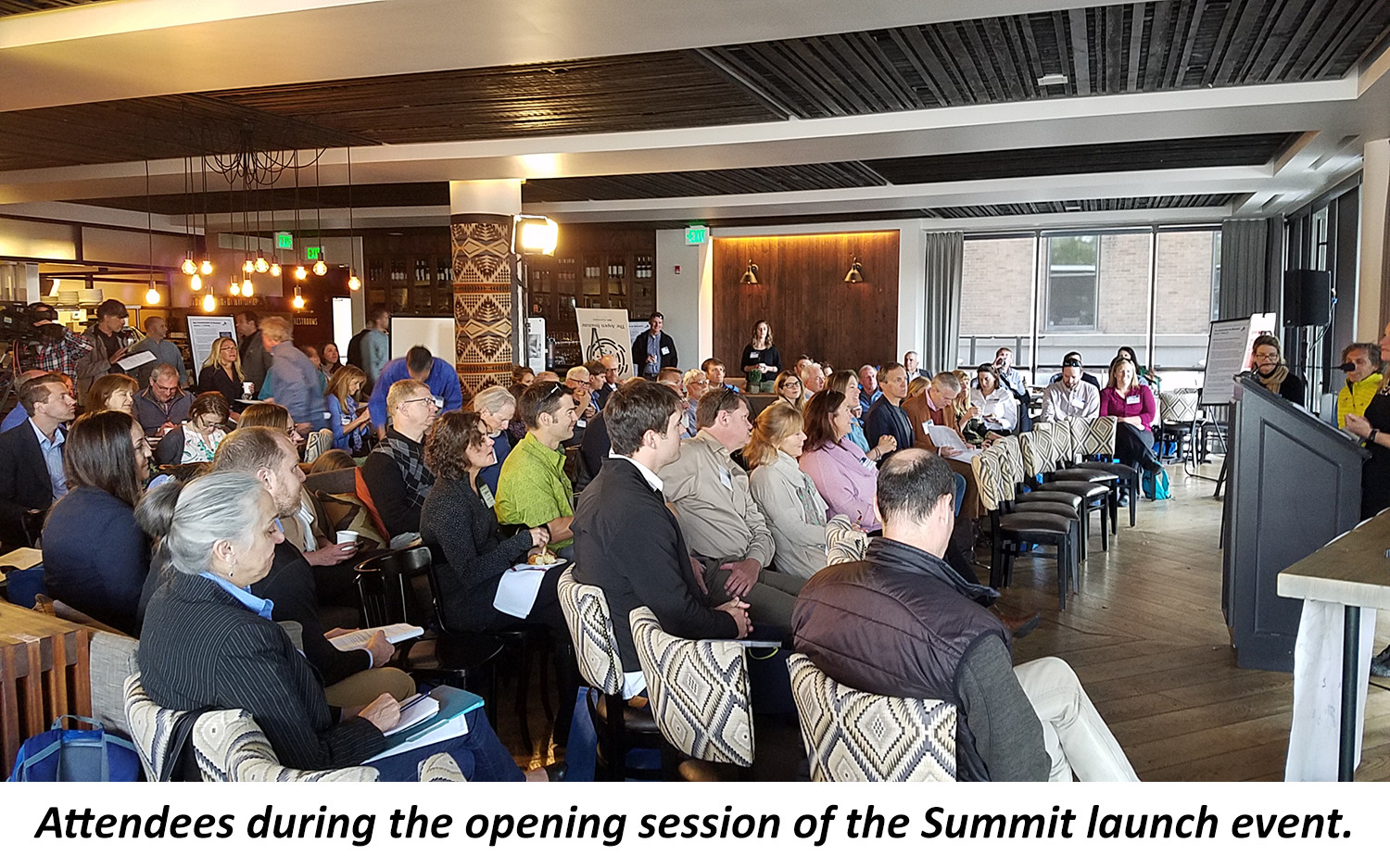
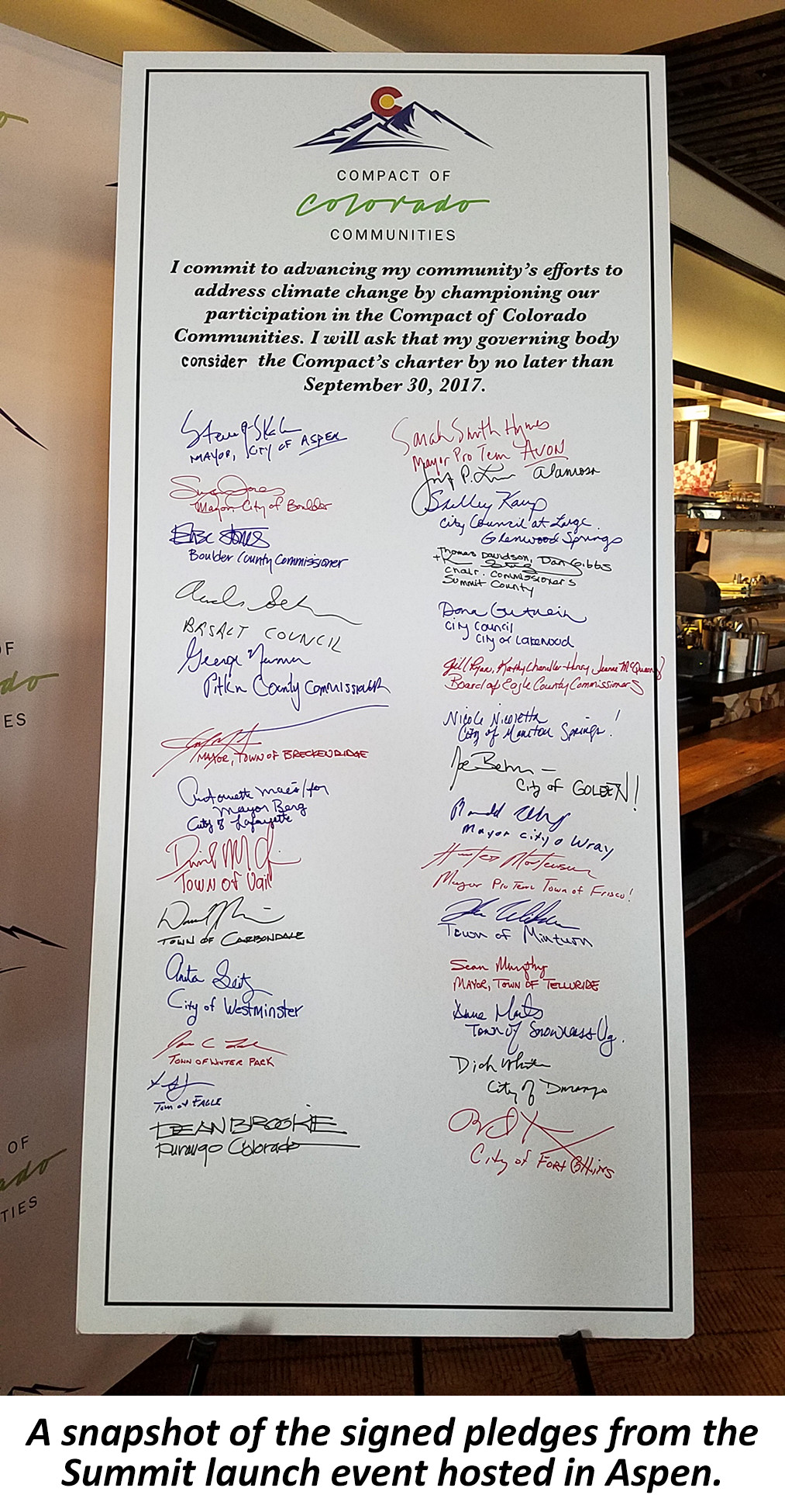
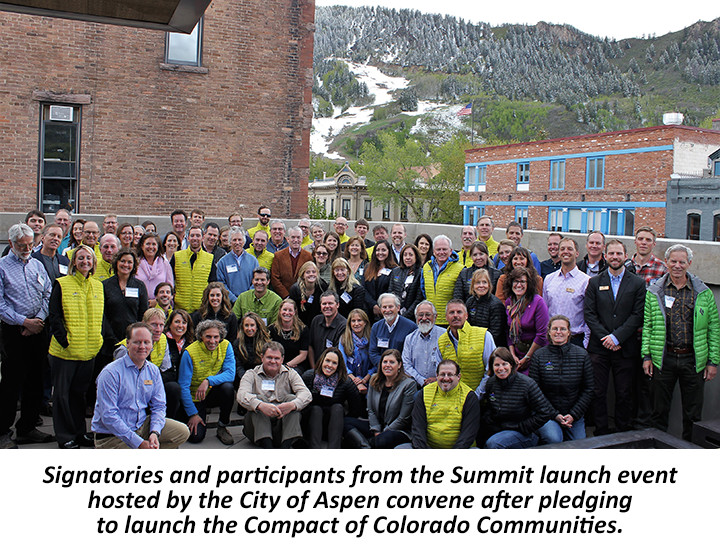
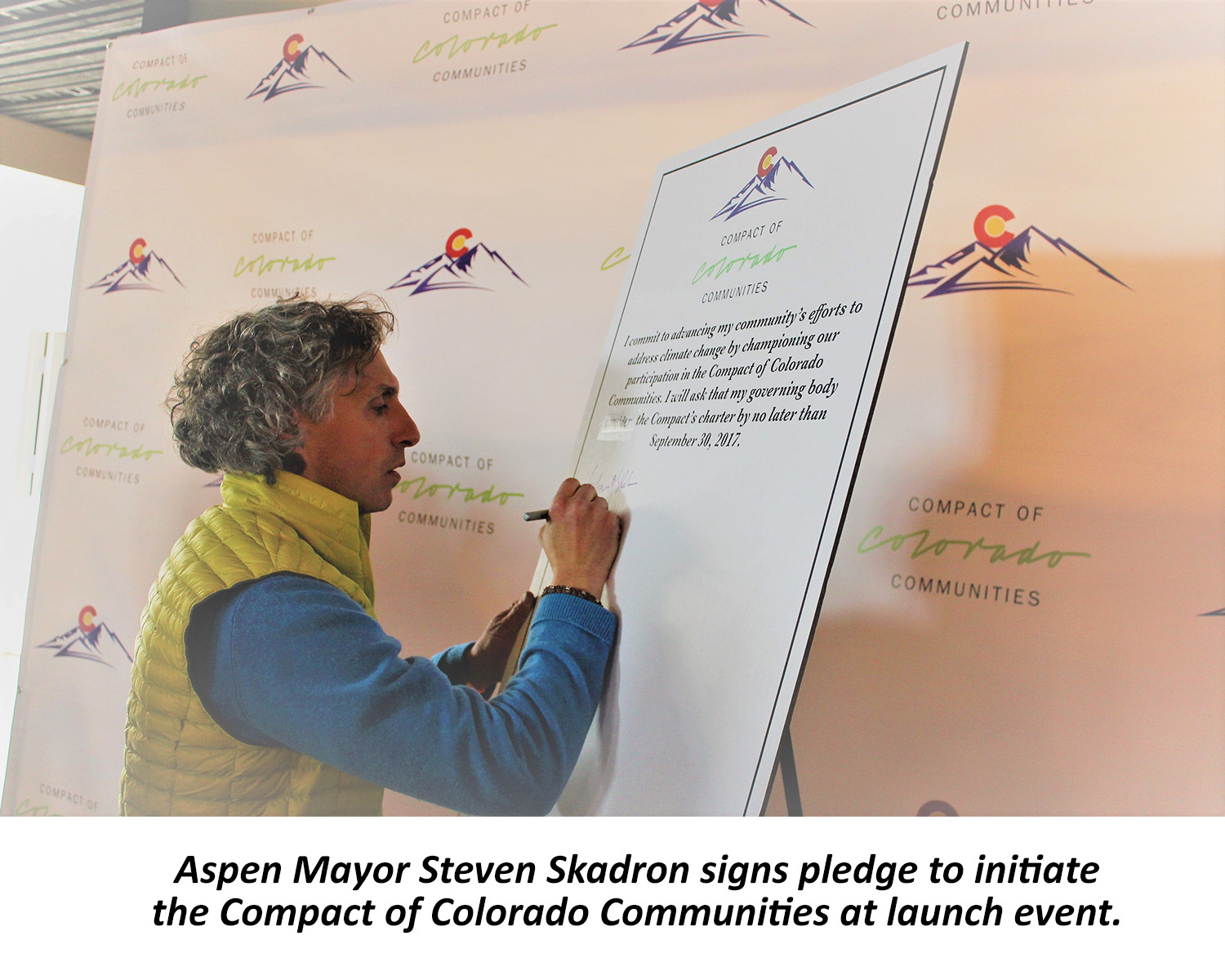
ASPEN, COLORADO - May 23, 2017 – At a City of Aspen statewide climate summit, elected officials and senior staff representing 27 local Colorado governments pledged to initiate a network called the Compact for Colorado Communities, a powerful tool for creating uniform climate change education, action, and policy statewide. The City of Aspen hosted the summit on May 19, 2017 with the goal of strengthening Colorado’s ability to fight climate change.
The 27 signatories at the summit pledged to present the Compact charter to their respective governing boards within 90 days, thus formally launching the Compact. The agreement symbolizes a collective commitment to aggressively act on climate change by focusing intently on building decision-making capacity and expertise within local governments.
The goal of the Compact for Colorado Communities is to form a unified network that will:
“Today’s theme is urgency, collaboration, and getting done locally what currently isn’t prioritized in the state or nationally,” Aspen Mayor Steven Skadron said at the Summit. He continued, “I believe no other state is better equipped or has a greater responsibility to lead the country toward a solution than Colorado. Aspen’s electric utility is the first in Colorado and the third in the nation to be powered by 100 percent renewable sources. I’d like to see Colorado become the first state in the country to be powered entirely by 100 percent renewable sources.”
The Compact was activated under the leadership of Mayor Skadron, Aspen’s Climate Action Manager, Ashley Perl, and the Association of Climate Change Officers (ACCO). ACCO played a key role in structuring the Compact’s requirements and will be providing critical climate preparedness training to elected officials and staff in all member communities. Additionally, ACCO will forge partnerships with peer non-profit organizations, state/federal government entities and technical experts across sectors to support the Compact’s members.
"The Compact of Colorado Communities reflects an understanding of elected officials and their senior staff that successful climate action will require a workforce and management team with updated competencies enabling better decision-making on greenhouse gas reduction, adaptive systems and resilience to extreme events. This is the first of its kind initiative to significantly scale up climate change knowledge and expertise in a region and will serve as a benchmark for successful climate action,” said Daniel Kreeger, ACCO’s executive director. “ACCO is pleased to play a role in accelerating this progress and is already actively looking to replicate this model effort.”
Pledge signatories included elected leaders from 22 cities including Boulder, Vail, Fort Collins, Basalt, Breckenridge, Lafayette, Carbondale, Westminster, Winter Park, Eagle, Avon, Alamosa, Glenwood Springs, Manitou Springs, Frisco, Minturn, Snowmass Village, Golden, Durango, Lakewood, Telluride and Wray, who were joined by Pitkin, Boulder, Eagle and Summit counties. Leaders from cities and counties such as Denver were unable to attend the launch event in person due to inclement weather the day before the event, but participated through a live stream of the event and have indicated verbally that they plan to join the Compact.
Colorado communities have already faced very significant climate change impacts and extreme events including shortened ski seasons affecting the economy, significant flood events and increased wildfires destroying real estate and infrastructure, droughts that have significantly impacted the agriculture sector, and pine beetle infestations that have ravaged trees statewide. Significantly expanding professional competencies and informed leadership in local governments will better prepare Colorado for climate change and extreme events while growing its economy.
For a complete list of participants and to learn more about the Compact of Colorado Communities, please visit http://Colorado.ACCOonline.org.
# # #
About the Compact of Colorado Communities
Founded by Aspen Mayor Steven Skadron and the Association of Climate Change Officers, the Compact of Colorado Communities has been established to bring cities and counties together to stand together in taking constructive and practical climate action. The Compact will dynamically advance and expand upon city and county efforts to address climate change, resilience to extreme events and grow a clean energy economy throughout Colorado. For more information about the Compact of Colorado Communities, please visit http://Colorado.ACCOonline.org.
About the City of Aspen
Located high in the Rocky Mountains, Aspen is the 53rd largest city in the state. Two hundred miles southwest of Denver and 130 miles east of Grand Junction, it is at the southeastern end of the Roaring Fork Valley. Aspen is surrounded by the White River National Forest. The City encompasses 3.66 square miles and is a relatively flat valley floor surrounded on three sides by Aspen, Smuggler and Red Mountains. It was founded in 1880 and incorporated in 1881. Aspen is internationally renowned as a winter and summer resort.
About the Association of Climate Change Officers
The Association of Climate Change Officers (ACCO) is a 501(c)(3) non-profit membership organization for executives and officials worldwide in industry, government, academia and the non-profit community. ACCO’s mission is to define, develop and support the functions, resources and communities necessary for effective organizational leadership in addressing climate-related risks and opportunities. ACCO administers the Certified Climate Change Professional® (CC-P®) and Certified Climate Change Officer® (CC-O®) credentialing programs. For more information about ACCO, please visit http://www.ACCOonline.org.

For more information, please contact:
Daniel Kreeger / Benn Grover
202-496-7390 / 888-461-0112
dkreeger@ACCOOnline.org / bgrover@hcwh.org
WASHINGTON, DC – May 3, 2017 – The Association of Climate Change Officers (ACCO) and Practice Greenhealth, organizations who have a common interest in advancing climate preparedness and sustainability in the healthcare sector, announced a partnership today that will advance their shared missions — to heighten the knowledge, skills, and professional growth of healthcare system professionals in the public and private sector.
Effective today, ACCO is providing a suite of climate science and greenhouse gas (GHG) management training modules available to all Practice Greenhealth members. Additionally, ACCO and Practice Greenhealth will begin to examine opportunities to align their efforts related to developing and disseminating new training resources, facilitating peer collaboration, and advancing important resources and tools.
The partnership builds upon a history of collaboration between the two organizations. ACCO and Practice Greenhealth will look to expand information sharing and the development of best practices so healthcare system practitioners will have access to valuable information and resources they need to heighten preparedness and reduce the footprint of their organizations.
“As a convening body and professional development organization, ACCO is joining forces with partner organizations to dynamically scale up important resources being made available to climate change and sustainability practitioners and to tailor training to specific sectors,” says Daniel Kreeger, ACCO’s co-founder and executive director. “We’re excited to unveil this important partnership with Practice Greenhealth and look forward to working collaboratively with their leadership to advance our critically important missions.”
This partnership represents a significant opportunity for the two communities of practice to work toward helping all healthcare organizations and systems to be more sustainable by building enterprise capacity and empowering their leadership to respond to climate change.
“Our member hospitals and health systems are ready to gain a deeper understanding of their carbon footprint, and ACCO is a great partner that is willing to share existing education and resources, as well as to explore other collaborative education opportunities,” says Sarah Manwell, Chief Membership Officer at Practice Greenhealth.
To learn more about the joint membership offering, please visit www.ACCOonline.org/greenhealth-trial.
About the Association of Climate Change Officers
The Association of Climate Change Officers (ACCO) is a 501(c)(3) non-profit membership organization for executives and officials worldwide in industry, government, academia and the non-profit community. ACCO’s mission is to define, develop and support the functions, resources and communities necessary for effective organizational leadership in addressing climate-related risks and opportunities. ACCO administers the Certified Climate Change Professional® (CC-P®) and Certified Climate Change Officer® (CC-O®) credentialing programs. For more information about ACCO, please visit www.accoonline.org.
About Practice Greenhealth
Practice Greenhealth is the leading nonprofit membership and network organization for sustainable health care, delivering environmental solutions to more than 1,300 members throughout the United States. Founded on the principles of positive environmental stewardship within the health care community, Practice Greenhealth lends its expertise to organizations looking to create safer, greener workplaces as well as improve the health of their patients, staff, and communities. To learn more about Practice Greenhealth, visit: www.practicegreenhealth.org
