
The Quiet Dismantling: What's Happening to Climate Work Beyond the Treaty Headlines
/Daniel Kreeger | January 24, 2026
I was on CGTN's Climate Watch this week with Zhao Ying. The topic was the US withdrawal from 66 international bodies, including the UNFCCC and the IPCC. The Paris Agreement departure becomes formal on January 27. There's a lot to say about the geopolitics. Most of it is being said.
Here's what I keep coming back to instead.
The ideology question is not new. The entanglement is.
I want to be careful here. Climate has always been ideological. Worldview affects how people interpret evidence, weigh tradeoffs, prioritize action, and decide who pays for what. That's true of climate, and it's true of every other complex policy challenge. It's not the problem.
What's new is that climate has become structurally entangled with a broader set of social and governance issues, and the entanglement is now being used to dismantle climate work along with the rest of the package.
How the Entanglement Happened
For the last twenty years, sustainability reporting has included a social pillar. That's not an accident, and it's not ideological. It reflects how the field actually developed.
The G in ESG stands for governance, the E for environmental, and the S for social. When companies built out sustainability programs, they built reporting infrastructure that covered emissions and climate risk on one side, and workforce composition, community impact, supply chain labor practices, human rights, and DEI commitments on the other. Both sat under the same umbrella. Both got reported in the same documents. Both were tracked by the same teams.
There were Good Reasons for that Integration:
Climate impacts hit different communities differently, so understanding those impacts requires social data
Workforce, supply chain, and community practices have environmental implications, and vice versa
Investors asking ESG questions wanted both kinds of data
The same reporting frameworks (GRI, SASB, the early TCFD work) covered both
The underlying argument for sustainability has always been that environmental, social, and governance dimensions are interconnected, because they actually are
This wasn't a political project. It was reporting practice that grew up over two decades because the data dependencies are real and the frameworks evolved to capture them.
What Changed
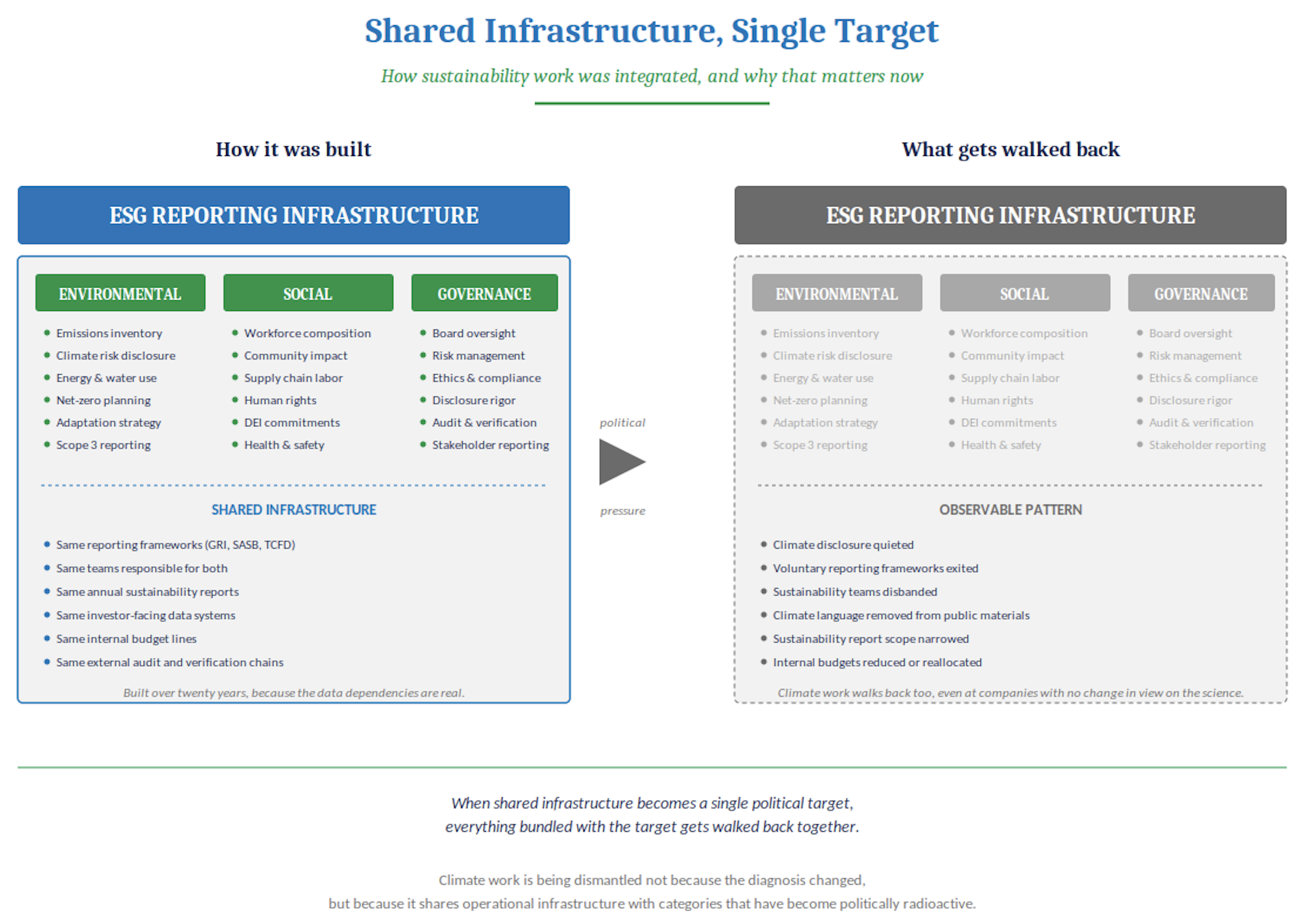
The political backlash against DEI and broader social commitments has now reached the point where companies are publicly retreating from those programs. That's a separate conversation with its own dynamics, and reasonable people will disagree about how companies should respond. But because social-pillar work was operationally embedded in sustainability infrastructure, companies pulling back from one part of that infrastructure are also:
Quieting their climate disclosure
Pulling out of voluntary reporting frameworks
Disbanding sustainability teams that did climate work
Removing climate language from public materials to avoid the broader political target
The result is that climate work is getting quietly walked back even at companies whose leadership genuinely understands climate risk to their operations. Not because they've changed their view on the science. Because the cost of being publicly associated with the broader sustainability package has become too high.
That's a different kind of problem than ideological disagreement about climate. And it has nothing to do with whether the social work itself is valuable. It's about what happens when shared infrastructure becomes a single political target.
The Cancer Analogy
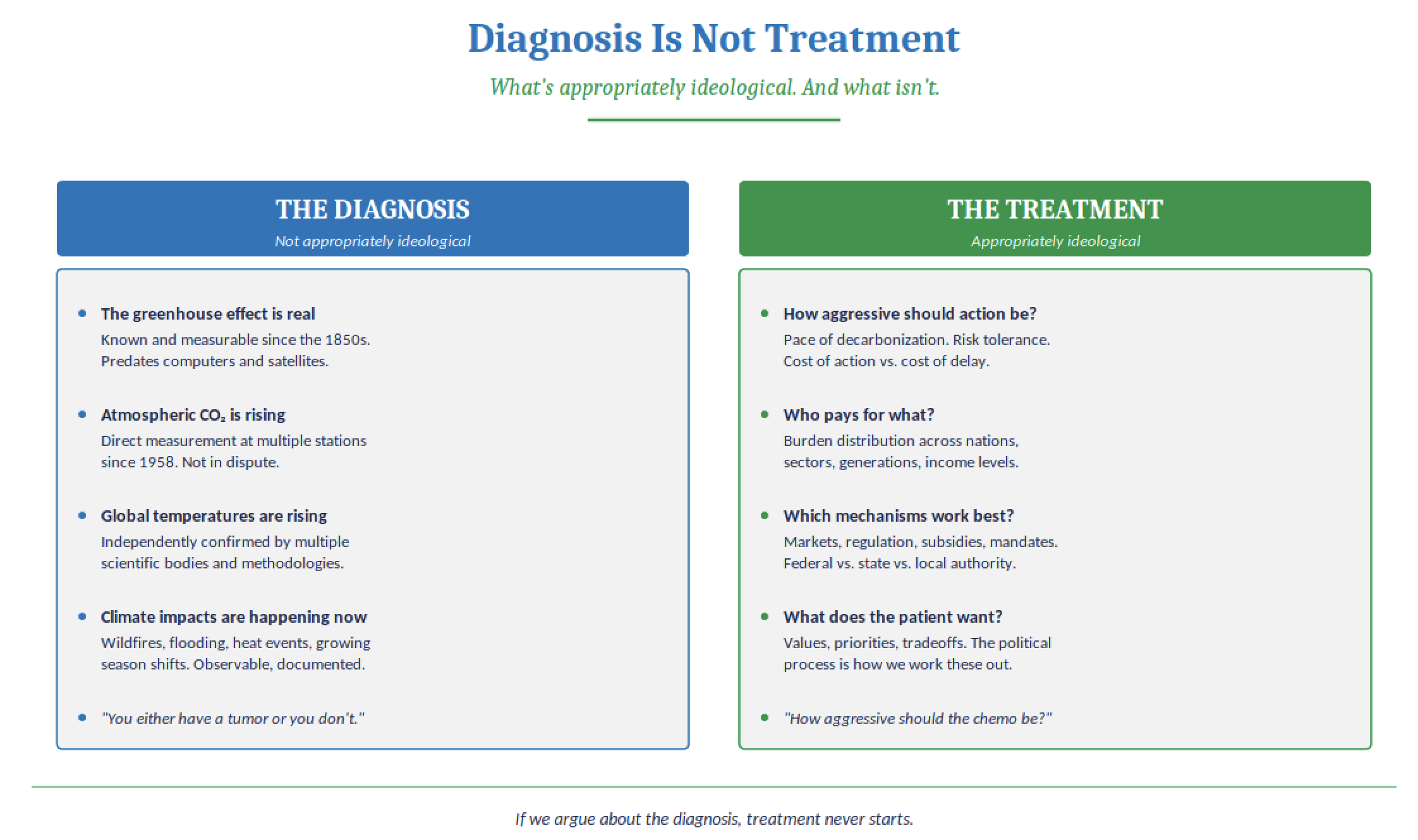
We've known about the greenhouse effect since the 1850s. Before computers. Before satellites. The science is measurable, testable, and has been tested. Whether human activity is changing the climate is not a belief. It is a finding.
Here's an analogy I've been using.
We don't have ideology about whether someone has cancer. The diagnosis is the diagnosis. You either have a tumor or you don't. You either carry a genetic marker or you don't.
What we can have is Legitimate Arguments about the Treatment:
How aggressive should the chemotherapy be?
What's the right balance between quality of life and life extension?
Who pays for what?
What does the patient want?
Those are appropriate ideological conversations. They reflect values, priorities, resources, and circumstances that vary from person to person.
But we do not argue about whether the cancer exists. If we did, we wouldn't be arguing about treatment. We'd be debating the validity of medical evidence itself, and treatment would never start.
That's where the climate conversation is now. Not because people suddenly stopped believing the science, but because the diagnosis has been bundled into a category of work that's politically radioactive, and the bundling makes it easier to walk away from the diagnosis than to fight for it separately.
Why this Matters More than Withdrawal from a Treaty
I'm not going to pretend the US withdrawal from the UNFCCC and IPCC doesn't matter. It does. The US is the second-largest emitter of greenhouse gases in the world. It's one of the two largest economies. It's a massive participant in everything from research funding to international finance. Pulling out of these bodies has real consequences for global climate cooperation, for scientific assessment, and for US credibility when a future administration wants to re-engage.
But treaties can be rejoined. Funding can be restored. Trust takes longer to rebuild than to lose, but it can be rebuilt.
The harder problem is what's happening at the company level, the local government level, the individual organization level. Climate work is getting quietly dismantled because it shares infrastructure with something else that's politically targeted. That dismantling is happening right now, in budget meetings and reorg announcements and sustainability report scope changes. It's happening even at companies whose leadership genuinely understands climate risk.
That's a much harder thing to recover from than a withdrawn signature, because it doesn't make news. It just shows up later as a gap.
What Stays True Regardless
A few things don't change based on what happens in Washington:
The atmosphere doesn't care who's at the table. The molecules are there or they aren't.
The United States is going to keep experiencing climate impacts. They were already happening before the withdrawal. They will continue afterward.
Cities, states, companies, and individuals are still going to make decisions that have to account for climate reality, whether the federal posture supports that or not.
Eventually, a different administration will be in office. The cycle has worked that way for the entire history of the country.
The climate change challenge continues. It looks different at the U.S. Federal level than it did three years ago, but it continues at the state, regional, organizational, and individual levels. And for those of us who do this work, the job hasn't really changed. The job is to deal honestly with what's actually happening, separate the diagnosis from the treatment, and help people make decisions that hold up over time.
That work doesn't depend on a treaty. It doesn't depend on the political weather around any particular set of related issues, even when those issues have become entangled with climate work in ways that make it harder to do our work.
Watch the segment on Climate Watch →
— Dan