
Why I'm Not Panicking About the Endangerment Finding
/Daniel Kreeger | August 8, 2025
I was on CGTN this week with Sean Callebs. The topic was the Trump administration's proposal to rescind the EPA's 2009 endangerment finding on greenhouse gases, along with the rollback of vehicle emissions standards, EV tax credits, and California's emission authority. The proposed rule landed in the Federal Register on August 1. Public hearings start August 19.
A lot of people I respect are sounding the alarm right now. The science community, public health groups, environmental organizations. They're not wrong to be concerned, but the conversation needs more historical perspective than it is getting.
I want to talk about why this looks familiar to me, and why the long-term outcome is more knowable than the short-term noise suggests.
The Story of Seat Belts in Cars
Here's a piece of regulatory history that most people have forgotten. In the 1960s, there was an argument about whether seat belts should be required in cars. Then there were arguments about which seats needed seatbelts and whether drivers and passengers should actually have to wear them. The Federal government tried to mandate them in the 1970s, then the Reagan Administration tried to repeal those rules in 1981 and the courts intervened, so the rules came back.
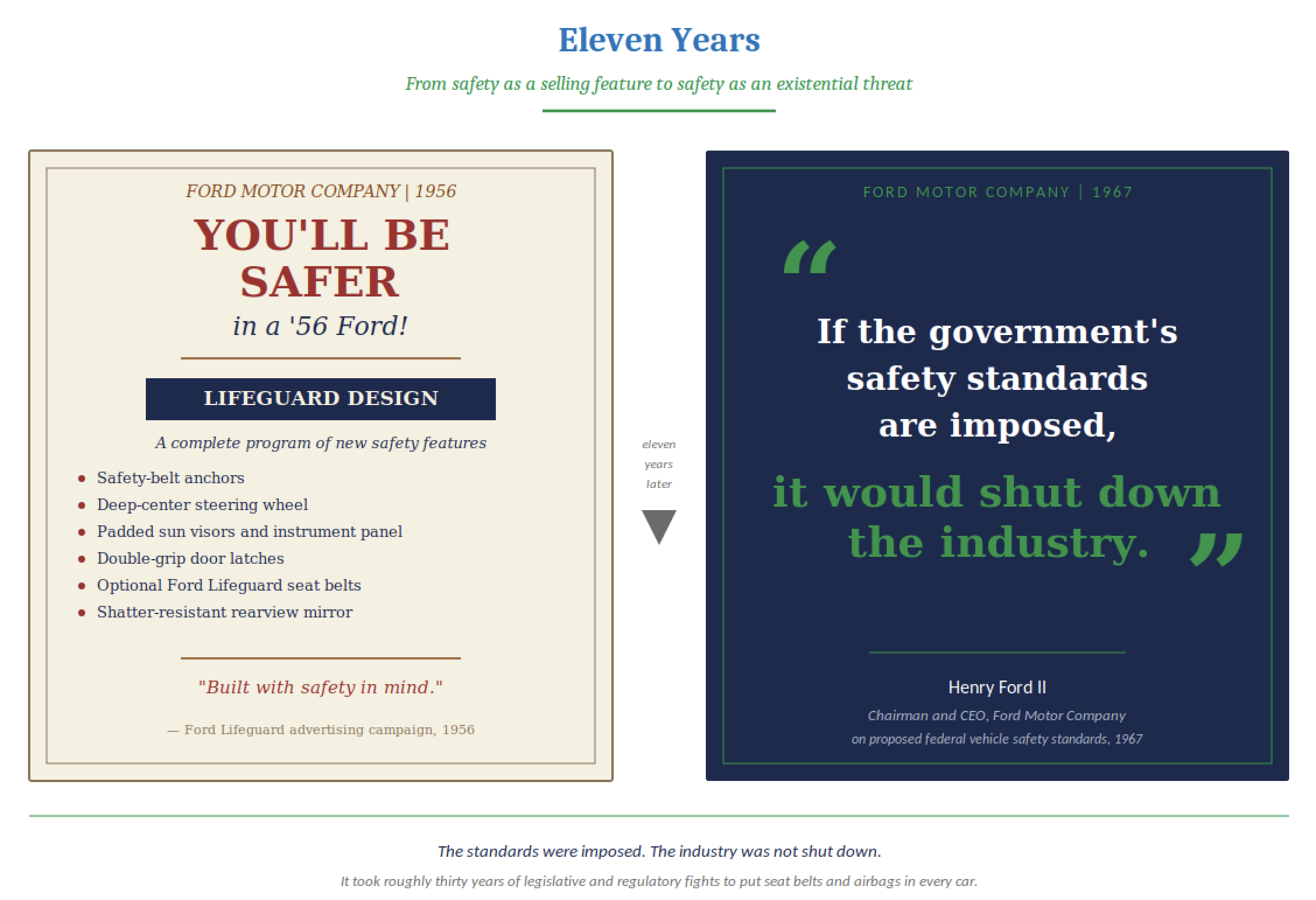
As a result of the Federal level fighting, state laws requiring seat belt use rolled out one state at a time across the 1980s. New Hampshire still doesn't have a mandatory seat belt law for adults. Side note, does this remind anyone of marriage rights 15 years ago?
The seat belt fight took place over roughly three decades.
Here's the part that should make you laugh, or cry, depending on your mood …
The airbag was invented in 1953. Patented. By a Pennsylvania industrial engineer named John Hetrick, who based the design on a torpedo's compressed-air launch mechanism. The technology existed. It worked. It was demonstrably effective at saving lives.
It didn't become standard equipment in U.S. passenger cars until 1998. Forty-five years after the patent.
While we were having a multi-decade fight about whether people should be required to put on a strap that already existed in the car, the technology that would have prevented many of the deaths we were arguing over was sitting on a shelf. Not because the technology didn't work. Because the regulatory and political will to deploy it didn't exist.
That's the pattern I see now with climate change.
Getting Back to Climate Change: What We Already Have
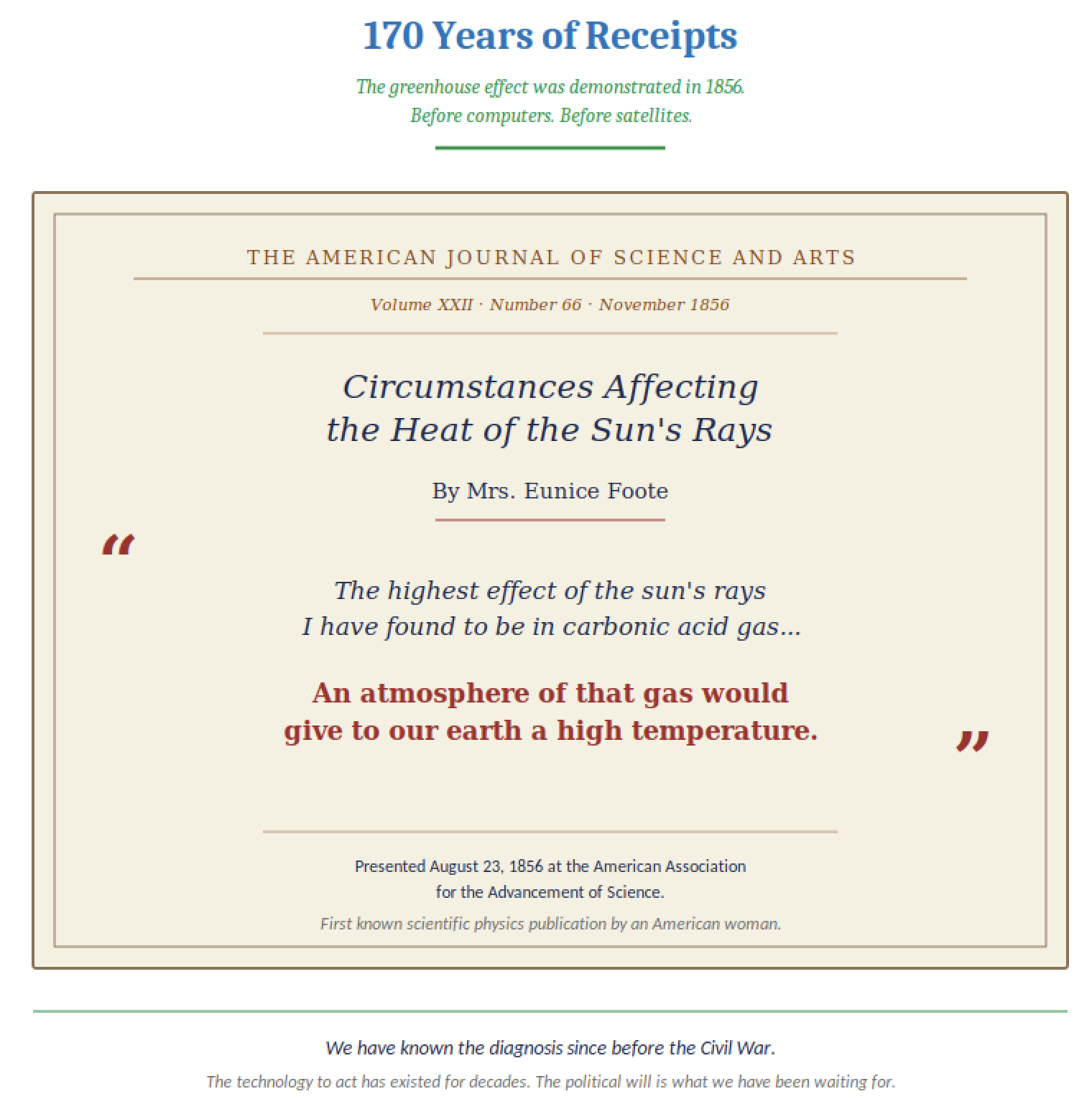
The science of climate change is not in dispute among scientists. We've known about the greenhouse effect since the 1850s. The fundamentals predate computers, satellites, and modern atmospheric science. They've been independently confirmed by every major scientific body on the planet that has examined the question.
A lot of the climate solutions already exist:
Solar generation that competes on price with fossil generation in most markets
Wind generation that has fundamentally restructured the electricity sector in many regions
Battery storage that solves a substantial part of the intermittency problem
Electric vehicles that are now cost-competitive in major markets
Industrial heat pumps, building electrification, grid management software
Carbon capture systems for hard-to-decarbonize industrial processes
Biofuels and synthetic fuels for aviation and heavy transport
Some of this technology is mature. Some of it is still developing. But the gap between "what we know how to do" and "what we're actually deploying at scale" is enormous, and most of that gap is not technological. It's regulatory, political, and economic.
We are merely repeating the seat belts and airbag pattern.
What the Endangerment Finding Actually Does
The 2009 endangerment finding wasn't an executive preference. It was the EPA's required response to the Supreme Court's 2007 ruling in Massachusetts v. EPA, which directed the agency to determine whether greenhouse gases endangered public health and welfare under the Clean Air Act. The science answered the question. The agency made the finding.
Sixteen years of regulation followed. Vehicle emission standards. Power plant rules. Oil and gas methane standards. Aircraft emissions. None of these regulations created the underlying climate science. They responded to it.
The current proposal asks the agency to rescind the finding by reinterpreting "air pollution" to exclude global climate concerns and by arguing that the science is now uncertain enough to warrant reversal. That argument has to survive judicial review under the Administrative Procedure Act. Agencies can change course, but they have to do so based on evidence and reasoning, not preference.
There is no peer-reviewed scientific pathway that supports the underlying argument the proposal is making. That matters in court even when it doesn't matter politically.
How I See this Playing Out
Based on the seat belt pattern and what we saw with previous Clean Air Act rollback attempts under the first Trump administration:
The proposed rule will move through public comment and likely get finalized in some form
It will be challenged in federal court by states, public health organizations, environmental groups, and probably some industry players who prefer regulatory certainty
Litigation will take years
The current Supreme Court is more deferential to executive action than past courts, so the outcome is less predictable than it would have been a decade ago
But even a sympathetic court has to deal with the requirement that agency reversals be based on reasoned analysis of evidence
Five to ten years from now, climate regulation is back. Either through a future administration restoring it, or through a court requiring it under the Clean Air Act
In the meantime, the science continues to be the science
The policy can be restored. That's the part that follows the seat belt pattern.
What Worries Me More
The legal trajectory is one thing. The operational damage is another, and that's where the seat belt analogy breaks down in an important way.
When the 1981 seat belt repeal attempt failed in court three years later, the regulatory infrastructure was still intact. The agency staff still existed. The data systems still existed. The federal-state coordination still existed. When the rules came back, the institutional capacity to enforce them came back with them.
That's not what's happening now.
Federal climate monitoring infrastructure takes decades to build and weeks to dismantle. Specialized scientific teams disperse when their programs get cut. Satellite missions that get canceled don't get rebuilt on the same timeline. Time-series climate data sets develop gaps that can't be filled retrospectively. Trained regulatory staff who leave don't come back when the policy does. Trust between U.S. agencies and international counterparts takes years to rebuild.
The policy is reversible. The institutional damage is harder to undo.
What Other Countries are Doing While We Argue
While we're having the latest version of this fight, others are continuing the work. Europe launched the MicroCarb satellite on July 26. It's a precision instrument for atmospheric CO2 monitoring with much higher resolution than what's been available before. China has had two operational carbon-tracking satellites since 2024. Both programs continue to expand.
The atmosphere doesn't care which country is monitoring it. The data still gets collected. But the U.S. is no longer the leader in climate monitoring, and we won't be again for a while.
In the auto industry, BYD and other Chinese EV manufacturers are advancing at a pace U.S. automakers can't match if they pivot back toward gasoline platforms. The product development cycle in automotive is five to seven years. Decisions made in 2025 determine market position in 2032. American manufacturers who walk back electrification now will be selling old technology into a market that has moved on.
Every step back from leadership creates space for others to take it. That's not new. That's just how leadership works.
What Stays True Regardless of What Happens with this Finding
A few things don't change based on what EPA does this year:
The Clean Air Act still says what it says
The Supreme Court precedent requiring reasoned agency decision-making still applies
The science is still the science
The technology that already works still works
States, cities, and companies still have their own authority, and many will continue to act
The product cycle in industry is much longer than the political cycle in Washington
The atmosphere doesn't read federal rules
The climate change work continues, and it must. Yes, it looks different at the U.S. Federal level than it did a year ago. But it continues at the state and local level, in industries where the long-term economics still favor cleaner technology, in the courts where precedent doesn't move on a four-year cycle, and in the international community that has its own infrastructure and its own assessments.
Eventually, the climate policy will come back. The question for those of us doing this work is what we lose in the meantime, and how much of it we can hold steady through the cycle. The airbag took forty-five years from invention to standard equipment. Climate change related technology can move faster than that, but only if we choose to deploy what we already have and make sensible business cases for climate action.
Watch the segment on YouTube →
— Dan