
The Past No Longer Predicts the Future
/Daniel Kreeger | Posted February 13, 2025
I was on CGTN with Diego Laje a few days ago. The conversation was about the consequences of elevated temperatures and extreme weather events. We covered a lot of ground, but there's an idea underneath the whole conversation that I want to spend some time with, because it changes how you think about climate risk if you take it seriously.
The historical record is no longer telling us what to expect.
What's Happening Right Now
We are in a La Niña season. La Niña is the cooler phase of a natural Pacific Ocean cycle. For as long as we have records, La Niña seasons have produced cooler-than-average global temperatures.
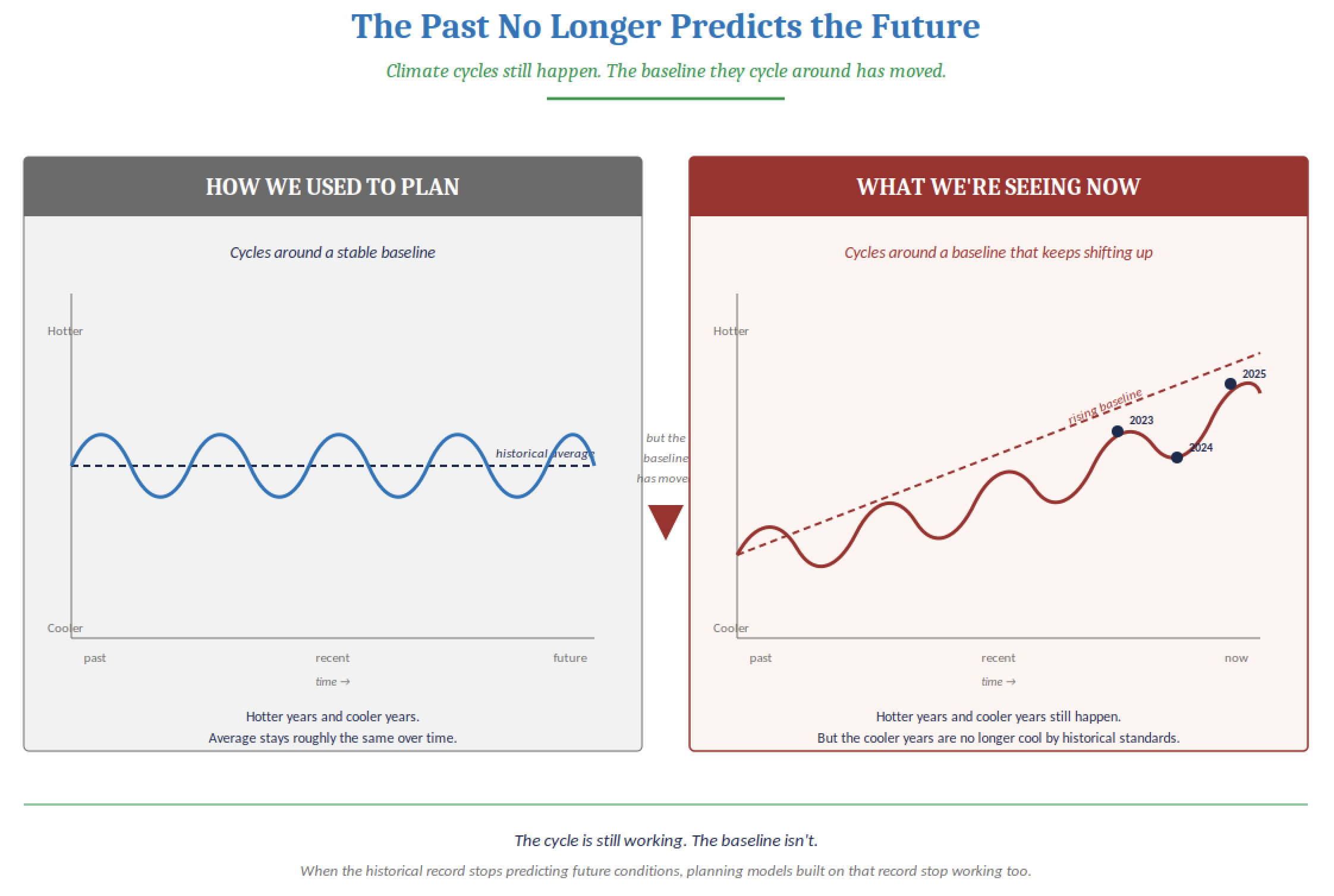
Right now, the global temperature is not running cooler. Last year was the warmest on record. January is on track to be exceptionally warm. The cycle is still functioning. The Pacific Ocean is still doing what the Pacific Ocean does. But the baseline around which everything cycles has shifted up so much that the cool phase is no longer cool by historical standards.
That observation has a name. Climate scientists call it nonstationarity, which is a clunky word for a simple idea: the past no longer predicts the future. The phrase "stationarity is dead" comes from a 2008 paper in Science by hydrologists at the U.S. Geological Survey. They were writing about water management, but the principle applies across the board. The conditions we used to assume would be roughly stable from one decade to the next are not stable. We can't plan as if they are.
Why this Matters More than It’s Just "Warmer"
Most people, when they think about climate change, think about it as a temperature shift. Things will be warmer. We will need to adapt to a warmer world.
If that were the whole story, we could handle it. We could update our planning for higher temperatures and move on. The math would still be predictable.
The harder problem is that the climate isn't just shifting to a new stable state. It's behaving in ways that don't match what the historical record predicts. That means:
Extreme events that used to happen once a century are happening every few years
Regions that have never flooded are flooding
Regions that have never burned are burning
Cycles still happen, but the floors and ceilings shift in ways we didn't expect
New combinations of conditions emerge that have no historical analog
If you are responsible for planning around climate risk, the implication is that the historical record has limited diagnostic value going forward. You can use it as a starting point. You cannot use it as a forecast.
Cascading Impacts
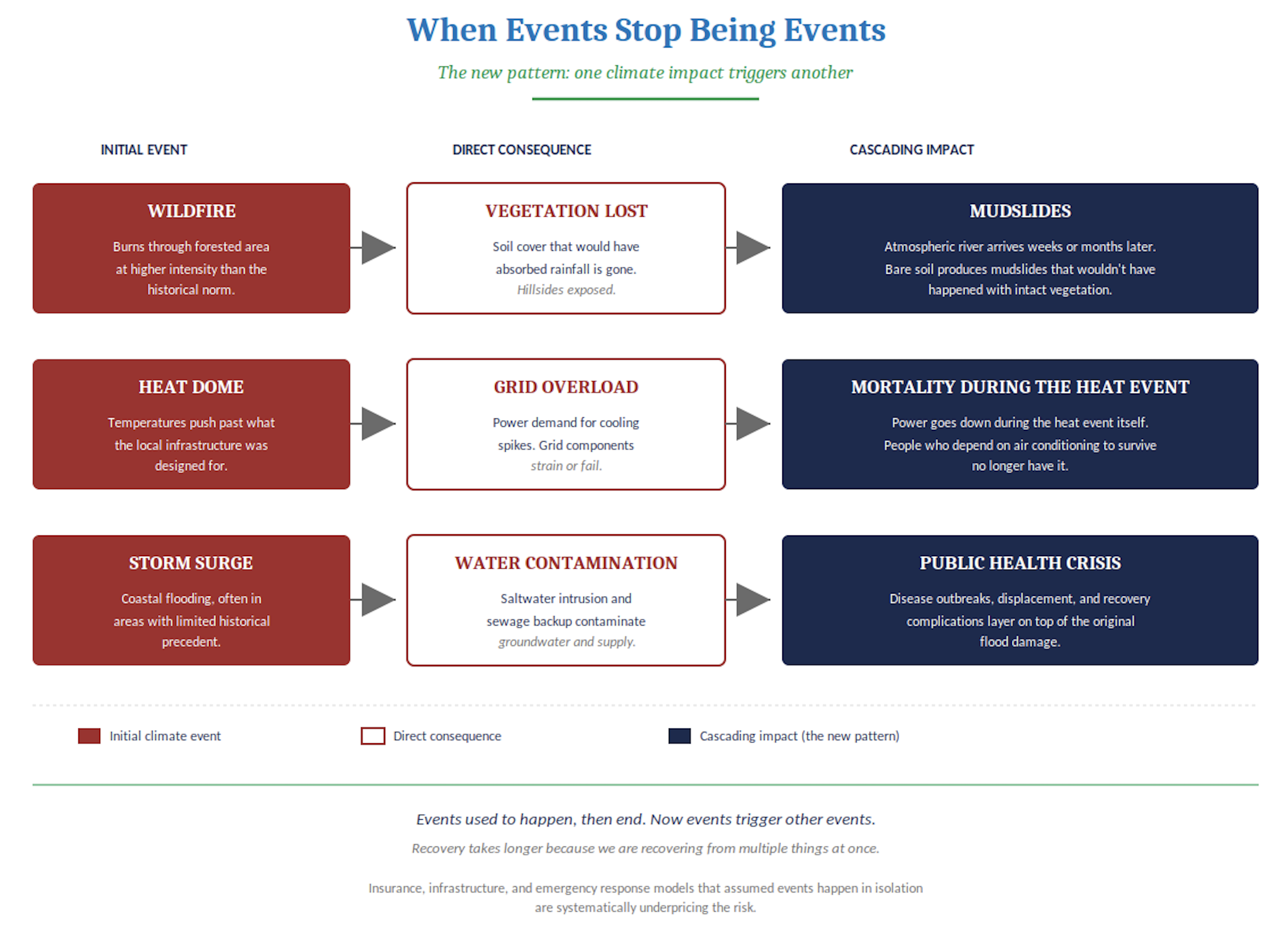
The other thing that's changing is that climate impacts no longer happen as discrete events.
In the historical pattern, you'd see a wildfire happen in a wildfire-prone area, then end. A flood in a flood-prone area, then end. A heat wave in summer, then end. People recovered. Communities rebuilt. The next event was a separate event.
What we're seeing now is different:
A wildfire scorches an area, removing the vegetation that would have absorbed rainfall, and an atmospheric river arrives months later, turning the bare soil into mudslides
A heat dome over a region pushes temperatures past what the power grid can handle, and the grid goes down during the heat event itself, killing people who depend on air conditioning
A storm surge floods a coastal area, contaminating the groundwater, and the area then has a public health crisis on top of the flood damage
A drought reduces hydropower output, fossil generation comes online to fill the gap, and emissions go up during the climate event that was driven by emissions in the first place
These are not isolated examples. This is the new pattern. Events trigger other events. Recovery takes longer because you are recovering from multiple things at once. Insurance models, infrastructure models, and emergency response models that assumed events would happen in isolation are systematically underpricing the risk.
What this Means for Planning
If you are responsible for risk planning at an organization, a government, a community, or a system, the questions that need to be asked right now include:
What assumptions in our planning models depend on historical climate patterns continuing to hold?
What would it cost us if those patterns shift by 20% in either direction?
Where are we exposed to compound events, where one climate-driven impact triggers a different kind of impact?
Where are we relying on systems that themselves depend on stable climate behavior to keep working?
What is our plan for events that have no historical precedent in our area?
These questions are not abstract. The answers determine whether the planning holds when something the model didn't predict actually happens.
What's Actually Advancing
The interview ended on a forward-looking note, and I want to do the same here, because the picture is not all dark.
A few sectors are moving fast enough to matter:
Battery technology has improved at a rate few would have predicted ten years ago. The cost curve is still going down. The energy density curve is still going up.
Electric vehicles continue to gain market share globally, even where federal policy is hostile. The product cycle in the auto industry is long enough that decisions made now determine market position for the next decade.
Small-scale nuclear is being announced and developed at an unusual pace. Not yet deployed at scale, but the project pipeline is real.
Hydrogen is still working through the infrastructure-versus-demand chicken-and-egg problem, but the research and development pipeline is substantial.
Renewables continue to expand. In many markets, they are now the cheapest source of new generation regardless of climate policy.
None of this is moving fast enough. But all of it is moving. The question is whether the pace of deployment can outrun the pace of the cascading impacts.
Who Drives the Climate Change Work Now
The political shift in the United States means the federal government is no longer driving climate action. That role moves to industry, to subnational governments, to philanthropy, and to the international community. We have seen this playbook before. What's different this time is that the federal departure is more comprehensive and more hostile, and is unfolding alongside a broader retreat from the institutional framework that has supported climate work for thirty years.
Some communities and organizations are being galvanized by this. Some are being dissuaded by the hostility of the political environment. Both responses are happening right now, in real time.
For those of us who do this work, the job is to keep the work moving in whatever venue still allows it to move. State governments, cities, companies, universities, philanthropies, international partners, and individuals are still going to make decisions that account for climate reality. The federal posture matters. It does not stop the work.
The atmosphere doesn't read federal rules. The cascading impacts don't pause for political cycles. And the historical record is not coming back.
Watch the segment on YouTube →
— Dan