When the Forests Don't Come Back
/Daniel Kreeger | July 24, 2023
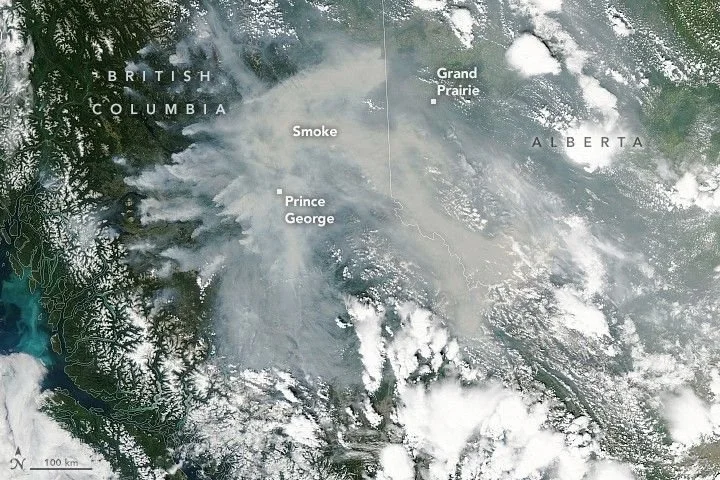
I was on CGTN with Sally Ayhan recently talking about Canada's wildfires. British Columbia is in its worst fire season on record. Hundreds of fires are burning at once. Smoke from those fires is reaching Chicago. A few weeks earlier, smoke from Quebec and Ontario fires had pushed into the U.S. Northeast and across the Atlantic to Europe.
The conversation kept coming back to air quality. That is the part of the story most people are tracking right now. There is a harder question underneath it that gets less attention.
Will the forests come back?
What are We Breathing?
The air quality concern is real and worth understanding. The pollutant we worry about most is PM 2.5, fine particulate matter small enough to enter the lungs and cause significant health damage. PM 2.5 is what wildfire smoke is largely made of.
Three things make this particular wildfire season especially dangerous:
Volatility of the Chemical: PM 2.5 does not interact well with the natural environment or with human respiratory systems. Even short exposure carries health consequences for vulnerable populations.
Length of Exposure: Atmospheric currents are stagnant in many parts of the affected regions. The smoke is not dissipating quickly. People in Chicago, the U.S. Midwest, and parts of the Northeast have been exposed for days at a time.
Combining with Extreme Heat: Hot air, stagnant air, and high concentrations of PM 2.5 reinforce each other. The respiratory consequences are worse when temperatures are also high.
That is the cocktail. Volatile chemical, longer exposure, intensified by heat. Public health authorities in affected regions have been issuing air quality alerts for weeks. Schools have canceled outdoor activities. Outdoor workers have been pulled inside.
This is the immediate concern. The longer concern is structural.
The Question about Regeneration
In a normal forest fire pattern, the cycle is destructive but bounded. Fires burn. Forests recover. Over years or decades, the ecosystem comes back. Old growth takes longer to recover than younger forests, but the basic cycle has held for as long as we have been observing it.
That cycle assumes a stable climate. Specifically, it assumes that the conditions that created the original forest will persist long enough for the forest to regrow.
That assumption is breaking down.
The 2023 British Columbia fires are happening in conditions that are not historically normal:
May was 6-10°C above the long-term average across much of the province
Snow melted faster than usual, leaving high-elevation areas dry earlier in the season
Lightning strikes in July were 55% above average, igniting more than 1,600 natural fires
Drought levels triggered water restrictions across two-thirds of British Columbia's watersheds
Pine beetle damage from the past two decades has left vast areas of dead, dry timber that burns more intensely than living forest
What this combination produces is not a one-time event. It is a new operating condition. The conditions that drove the 2023 fire season are continuing to intensify. Lightning strikes will keep coming. Heat waves will keep coming. Drought will keep coming.
If those conditions continue, the regeneration cycle does not have time to operate. Burned areas may begin to recover, then burn again before recovery is complete. New growth may struggle to establish in conditions hotter and drier than what the species evolved for. Over time, what comes back may not be the same forest that burned. It may be different species, different density, different biomass. In some cases, what was forest may not return as forest at all.
The honest word for what we are looking at is existential. I do not use that word lightly. We may be watching the end of certain forest ecosystems on timescales of decades, not millennia.
Both Local and Global Action are Required
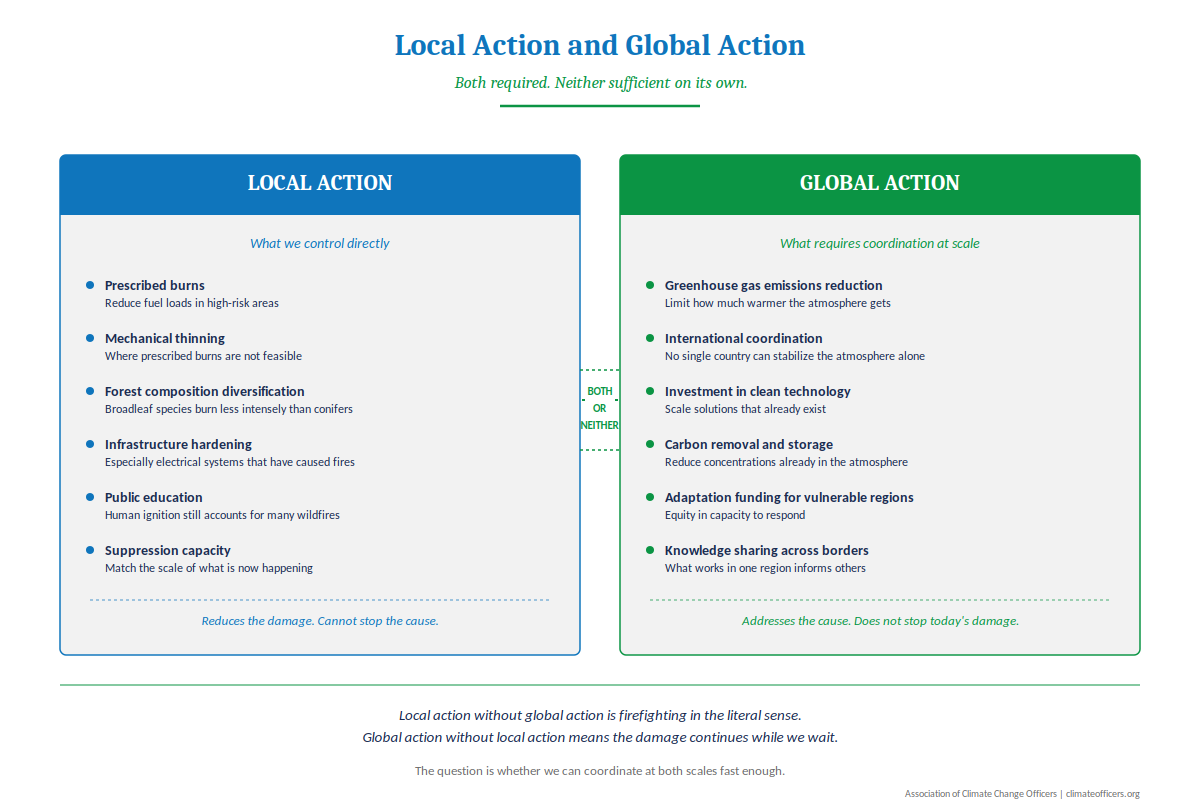
There are things we need to do at the local level and things we need to do at the global level. Neither is sufficient on its own.
At the local level, forest management has to evolve:
Prescribed burns to reduce fuel loads in high-risk areas
Mechanical thinning where prescribed burns are not feasible
Diversification of forest composition to include broadleaf species that burn less intensely than conifers
Better infrastructure protection, including hardening of electrical systems that have caused fires in past seasons
Public education on fire prevention, since human ignition still accounts for a meaningful share of wildfires
Investment in suppression capacity that can match the scale of what is now happening
These are not new ideas. Forestry researchers have been recommending them for decades. The challenge is implementation at the scale and pace the situation now requires.
At the global level, the underlying driver has to be addressed:
Greenhouse gas emissions need to come down to limit how much warmer the planet gets
The warmer the atmosphere, the more extreme the conditions that drive these fires
Without emissions reduction, the local-level work is fighting the symptoms while the cause continues to intensify
Local action without global action is firefighting in the literal sense. It will save what can be saved. It cannot stop the conditions from getting worse.
Global action without local action means the local-level damage continues even as we eventually slow the underlying driver. Both have to happen at the same time. The question is whether we can coordinate at both scales fast enough.
What Stays True Regardless
The fires this year are not an anomaly … they are part of a pattern that has been intensifying for two decades. With a certain amount and rate of climate change already baked in, the pattern will continue.
The question is whether the human and ecological systems that depend on these forests can adapt fast enough, and whether we are willing to do the local and global work it would take to give those systems a chance.
The forests do not have a vote in this. Our communities that depend upon those forests, and/or the are adjacent to those forests, absolutely do have a vote and a duty to act and to prepare.
Watch the segment on YouTube →
— Dan