Why People Don't Connect the Dots
/Daniel Kreeger | January 18, 2023
I was on CGTN's China 24 with Mike Walter a few days ago. We covered a lot of ground. China's annual climate report. Greenland and Antarctic ice loss. Pakistan flooding from last summer. California right now, where atmospheric rivers have killed at least seventeen people in two weeks of back-to-back storms following years of drought.
The part of the conversation I keep coming back to are the harder questions Mike asked at the end:
Is this getting enough attention?
What should policymakers be doing?
I gave an honest answer. Most people are not connecting the dots between climate change and the things they actually care about. Until we do that, the political pressure to act stays weaker than the political pressure not to.
The Pinball Table is Tilted
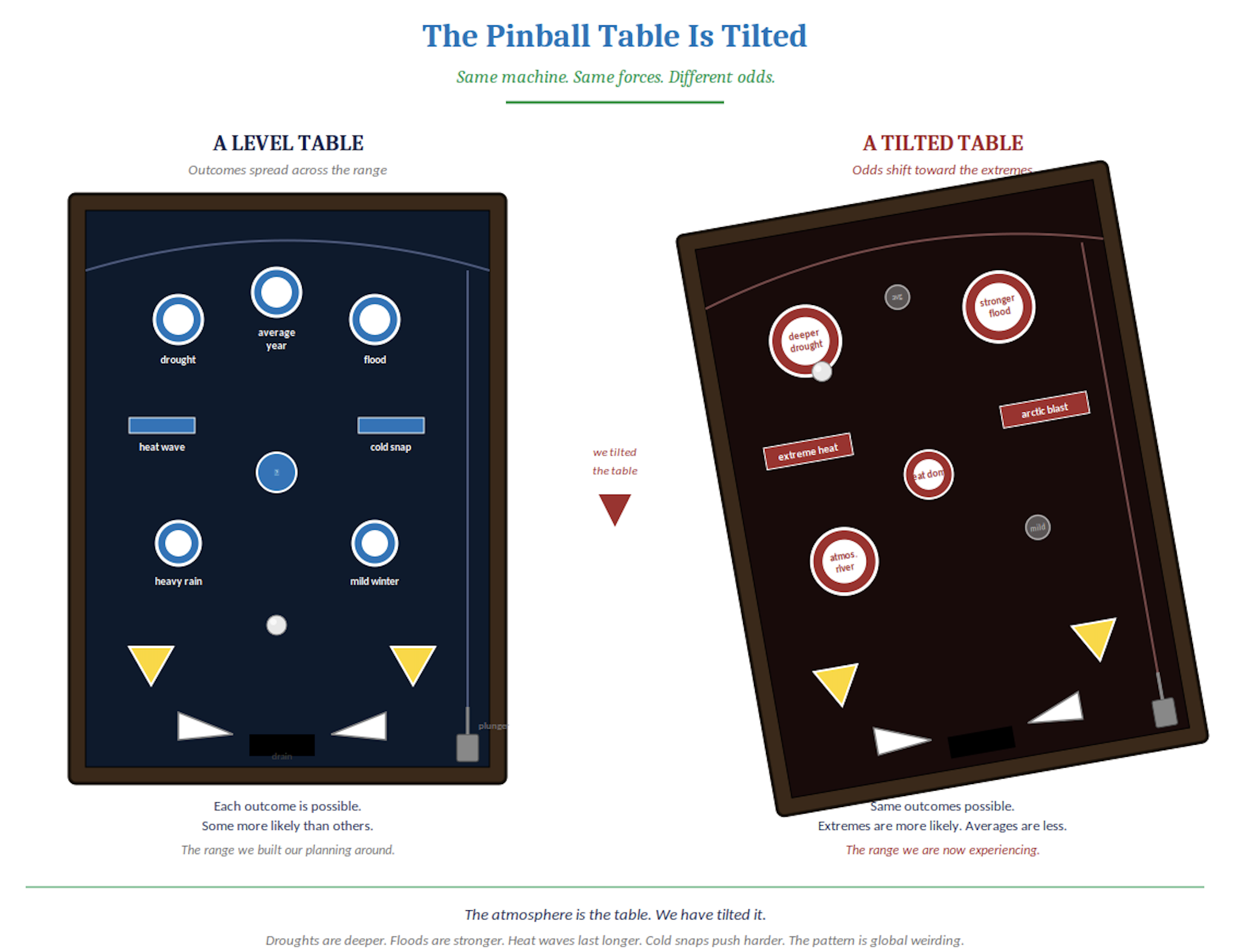
Climate change is not a smooth line. It is not a steady warming trend that everyone experiences equally and predictably.
What we are seeing is volatility. The probability of extremes is getting greater. I have started calling this pattern global weirding, because it captures what is actually happening better than the standard framing does.
The way I think about it is a pinball table. A pinball table is designed so the ball can land in many places, with some outcomes more likely to occur than others. If you tilt the table, you change the odds. The same machine, the same ball, the same forces, but the probability of where the ball ends up shifts.
We have tilted the atmosphere. The same machine is running, but the odds of the outcomes have changed:
Droughts are deeper and longer
Floods are more severe and more frequent
High-precipitation events are stronger
Sea level is rising
Heat waves and cold snaps both push past historical extremes
All of this is happening more frequently, more significantly, and for longer durations than we are accustomed to seeing. California is a high-profile example of that volatility, though it is not certainly not unique (Pakistan has been experiencing swings as well). Greenland and Antarctica are the slower-moving examples that we will be reckoning with for decades.
The Freight Train is Already Here
There is a version of this conversation I was having ten or fifteen years ago, when the standard framing was that climate change was an oncoming freight train. We had time to prepare. Time to debate. Time to argue about whether the train was real.
Well, the freight train is right upon us now. We are now in the period where the question is no longer "is this happening." The question is what we are going to do about it now that it is happening?
Why People Aren’t Preparing Accordingly
Here is the part that gets less attention. Most people I talk to outside this field do not think of climate change as their top priority. Inflation is higher on the list. Cost of living. Safety. Food prices. Job stability. Political stability.
That is not a failure of values. It is a failure of connection. The things people care most about are directly affected by climate change.
Cost of food depends on stable growing seasons, predictable rainfall, and functioning supply chains
Health care costs are rising in part because of heat-related illness, vector-borne disease, and air-quality impacts from wildfires
Job stability depends on whether your industry, your region, and your employer can continue operating through climate-driven disruptions
Safety depends on whether emergency systems can handle compound and cascading events
Political stability in many parts of the world is tied directly to access to water and food
When the freight train arrives, it does not announce itself as climate change. It announces itself as higher grocery bills, insurance non-renewal letters, wildfire smoke advisory. As a child who cannot go to school because of a heat dome. As a home that lost 70% of its value because the area is no longer insurable.
People feel these things. They do not always know why they are happening. The work that climate professionals have not done well enough is connecting those experiences back to the underlying cause in a way that lands.
What Would I Say to Policymakers
I would tell them three things:
Policymakers are influenced by the will of the people. If the public does not see climate change as connected to what they care about, the political will to act stays weak. That means the work of building the connection is upstream of the policy fight.
Every dollar spent on infrastructure today should be spent with future-proofing in mind. Adaptive, resilient, and emissions-reducing all at once. One of those without the others is incomplete.
Climate change and preparedness need to be number one on the priority list. For governments, for industry, and for individual behavior. Not because climate change is more important than every other concern, but because climate change is the medium through which almost every other concern is being made worse.
What Stays True Regardless
The pinball table is still tilted. The freight train is still here. The atmosphere is still changing.
The work going forward is at every scale. International. National. State and local. Industry. Community. Individual. None of these can wait for the others. None of them is sufficient on its own.
The question is whether we connect the dots between what is happening and what we care about, fast enough to do something about it.
Watch the segment on YouTube →
— Dan