
Is 2024 the Year We Stopped Pretending?
/Daniel Kreeger | December 31, 2024

We are about to close out what looks set to be the warmest year in the historical record. The official confirmation will come from NASA and NOAA in the next couple of weeks. The numbers from monitoring agencies through the fall left little doubt.
That fact alone is significant, but what is more significant, is what 2024 looked like underneath that single number.
Twenty-seven billion-dollar weather and climate disasters hit the United States. Hurricane Helene devastated western North Carolina. Hurricane Milton tore through Florida's Gulf Coast two weeks later. Wildfires continued in Canada. The Amazon basin saw its worst drought on record. Bangladesh experienced catastrophic flooding. The Mediterranean recorded sea surface temperatures that would have been unimaginable a decade ago.
The same warming did not hit these places the same way.
Global Warming Means Unequal Local Impacts
Global average temperature is a useful indicator. It is not a useful predictor of what any specific place experienced this year.
The year's warming worked through the climate system in ways that landed disproportionately on places already disadvantaged in their capacity to respond:
Bangladesh has minimal historical responsibility for emissions and minimal fiscal capacity to recover from compound flood events
Western North Carolina was not part of the design assumptions for the modern hurricane response system because its historical risk was lower
The Amazon's worst-on-record drought hit communities whose livelihoods depend on river-based transportation and fishing
Pacific island nations continued losing land to sea-level rise that they did not cause and cannot stop
Heat-related deaths globally are concentrated in places that lack air conditioning, reliable electricity, or both
This is not a failure of climate models. It is what the models predicted. The warming is global. The impacts are local. The capacity to respond is unevenly distributed in ways that track historical patterns of wealth, infrastructure, and political stability.
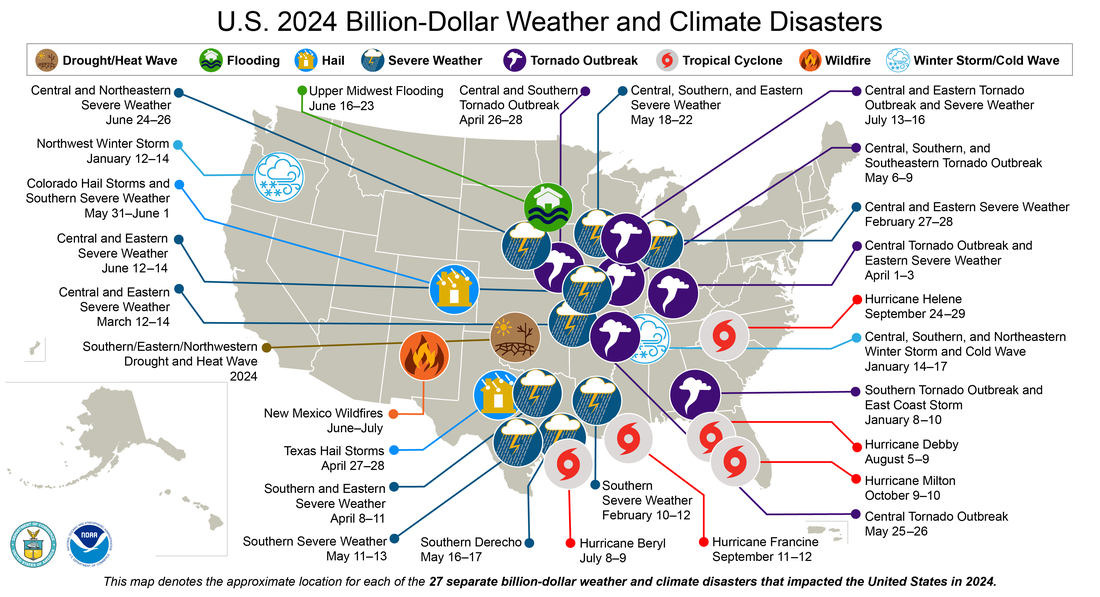
Source: NOAA (Updated in January 2025)
https://www.climate.gov/news-features/blogs/beyond-data/2024-active-year-us-billion-dollar-weather-and-climate-disasters
What Should Make 2024 Undeniable
Several things became harder to deny over the course of this year.
The signal is no longer ambiguous: The annual record-breaking temperatures, the cascade of billion-dollar disasters, the back-to-back extreme events in the same regions — none of this is statistical noise. The pattern is exactly what climate science has been describing for forty years. The honest debate now is about pace and consequence, not whether it is happening.
Adaptation gaps are showing up faster than adaptation investment: Western North Carolina did not have hurricane-prepared infrastructure because it had not historically needed it. By the time Helene arrived, building it would have taken decades. The places that need to adapt fastest are often the places with the least capacity to do so.
Insurance and capital markets are no longer waiting for political consensus: Reinsurance has been pricing climate change for decades. In 2024, primary insurance markets in Florida, California, and elsewhere visibly reflected what the math has been saying. Lenders are following. The market response is structural, not ideological.
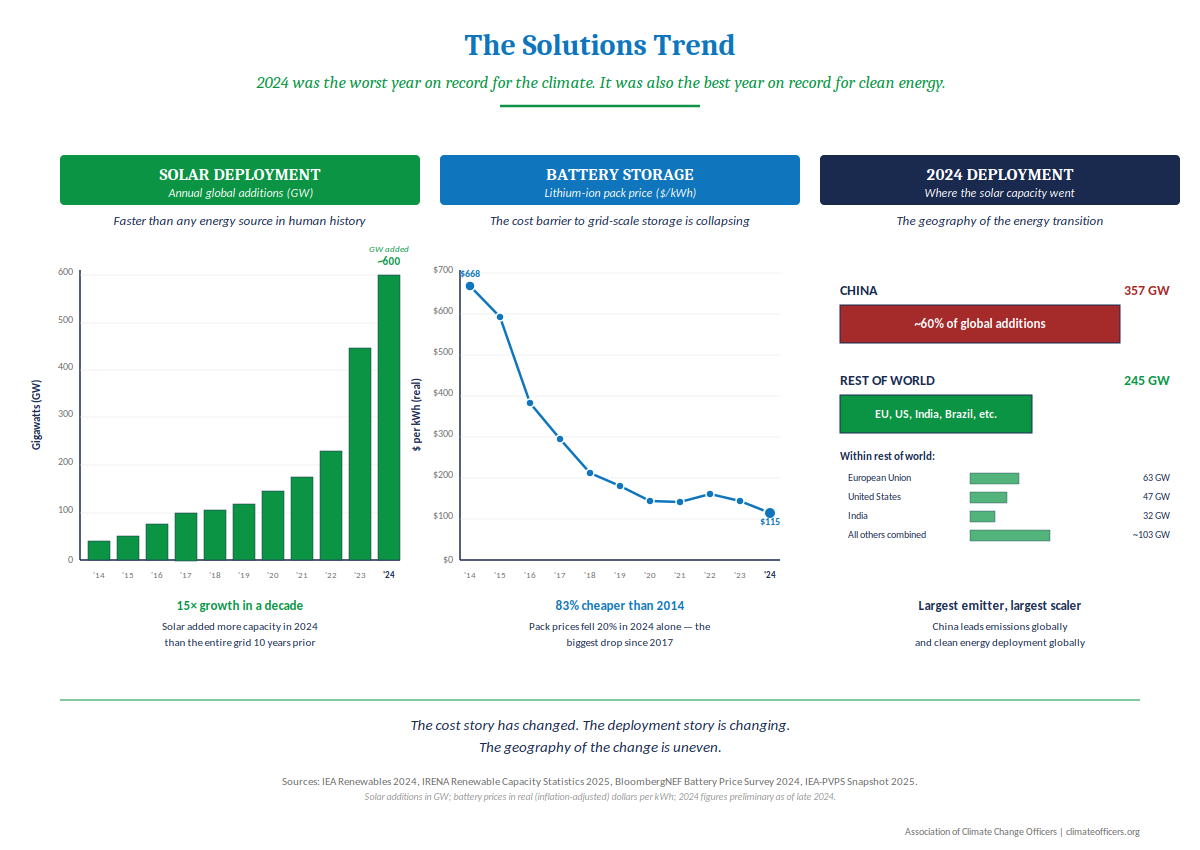
The places driving the most emissions are also driving the most clean energy deployment: China remained the world's largest emitter in 2024. China also installed more solar, wind, and battery storage capacity in 2024 than the rest of the world combined. The story is not simple. The dual role complicates the narrative that places this country in any single column.
What 2024 Also Showed Us
Not everything this year was bleak. Several patterns deserve attention.
Renewable energy continued its cost-driven growth: Solar generation in 2024 grew faster than any energy source in human history. Battery storage costs continued to fall. The economics of clean energy now favor it in most markets without subsidies. Deployment is now constrained by grid capacity, permitting, and supply chains, not by cost.
Some communities executed well under pressure: Florida's Gulf Coast preparation for Hurricane Milton, while imperfect, performed at a level that decades of post-Andrew investment made possible. The contrast with western North Carolina's experience two weeks earlier was not a story of competence versus incompetence. It was a story of preparation accumulated over thirty years versus preparation the underlying risk profile did not call for until now.
Climate became operationally relevant in places that had been resistant: Risk officers, insurance regulators, water managers, and infrastructure planners in places that had treated climate change as a distant concern increasingly cannot avoid the operational implications. The conversation has shifted from "is this real" to "what do we do."
Harder Questions for 2025 and Beyond
Three questions stand out as the year ends:
How fast can adaptation move in places that need it most? The science of adaptation is reasonably well understood. The financing, governance, and political economy of adaptation in vulnerable places is the harder problem. The answer determines how livable many regions will be by the end of the decade.
Will the regulatory frameworks catch up to the market? Primary insurance regulation, building codes, zoning ordinances, and emergency management systems were all designed for a stationary climate. They are visibly straining. The question is whether they get modernized through deliberate policy or through cascading failures.
Will the wealthier emitters fund adaptation in the places most affected? This is the core unresolved question of every COP negotiation since 2009. The amounts pledged remain orders of magnitude smaller than the amounts needed. The political economy of cross-border adaptation finance has not improved this year.
The atmosphere does not care which country emitted the gas molecule. The climate change those emissions are driving does not stop at national borders or income levels. What is unequal is who emitted, who suffers, and who has the resources to respond.
The work of 2025 and the years following is not about waking up to the problem. The problem has been awake for decades. The work is about whether our response can match the pace and the geographic reach of the consequences.
That is an open question. It has been an open question for a long time. The closing of 2024 is a useful moment to ask it directly, because the year just demonstrated, in concrete and sometimes catastrophic terms, what the cost is of leaving it open.
Watch the segment on YouTube →
— Dan